
AI and Crypto Roundup: Anthropic's Record IPO, Nvidia's First Quarter Without Huang, and Bitcoin Falls Below $60K
Anthropic completes the largest IPO ever, Nvidia posts record sales without Jensen Huang, a computer-checked proof of the Riemann Hypothesis, and Bitcoin falls below $60,000 to its lowest since September 2024.
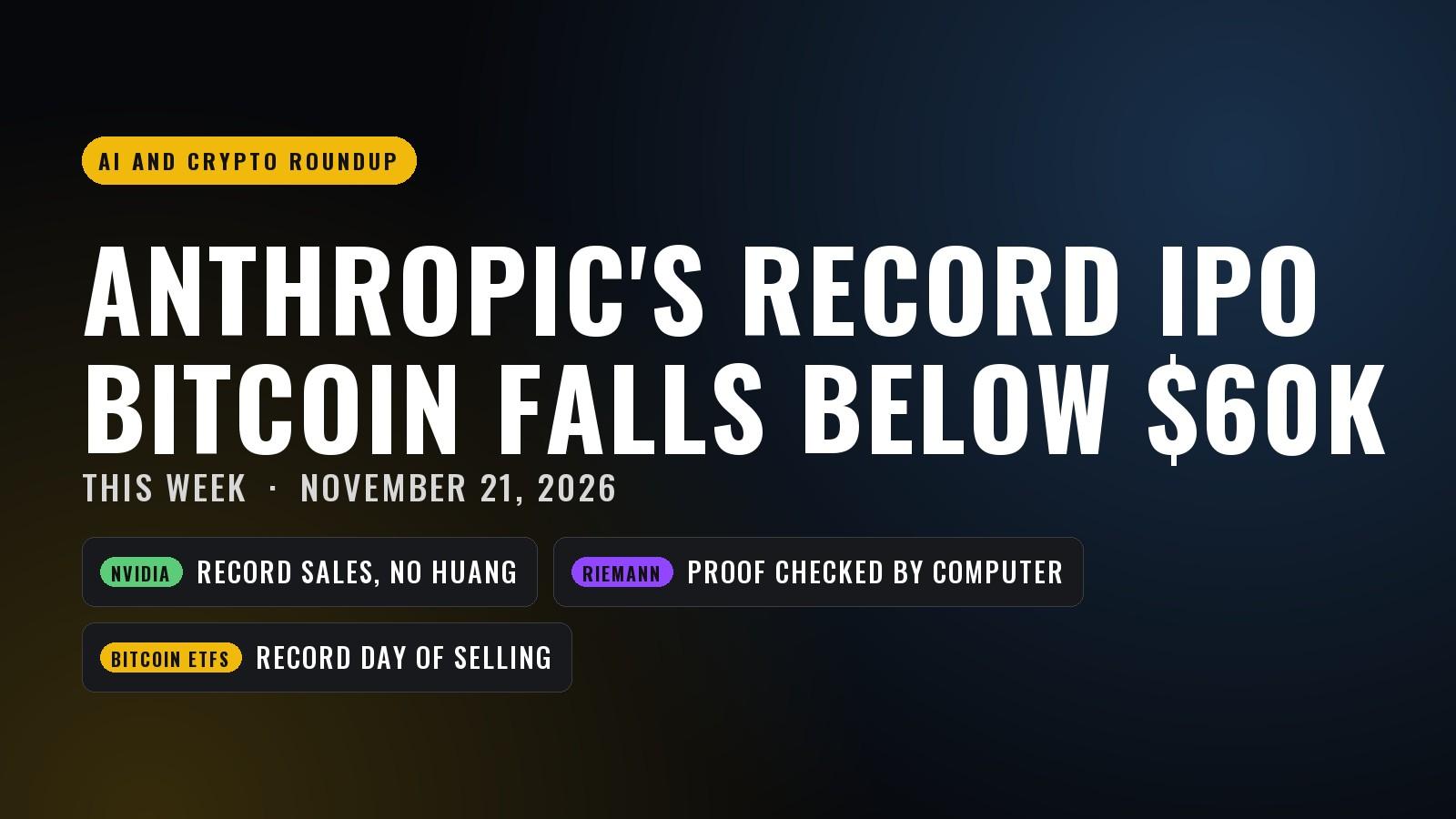
It was a week of records in both directions. Anthropic completed the largest IPO ever, then watched its shares give back their gains as AI stocks sold off hard on Friday. Nvidia posted record sales in its first quarter without Jensen Huang, and Bitcoin fell below $60,000 for the first time since July before sliding to its lowest price since September 2024. Here is what mattered since our last roundup on November 12.
AI
Anthropic's record IPO, and a rough second day
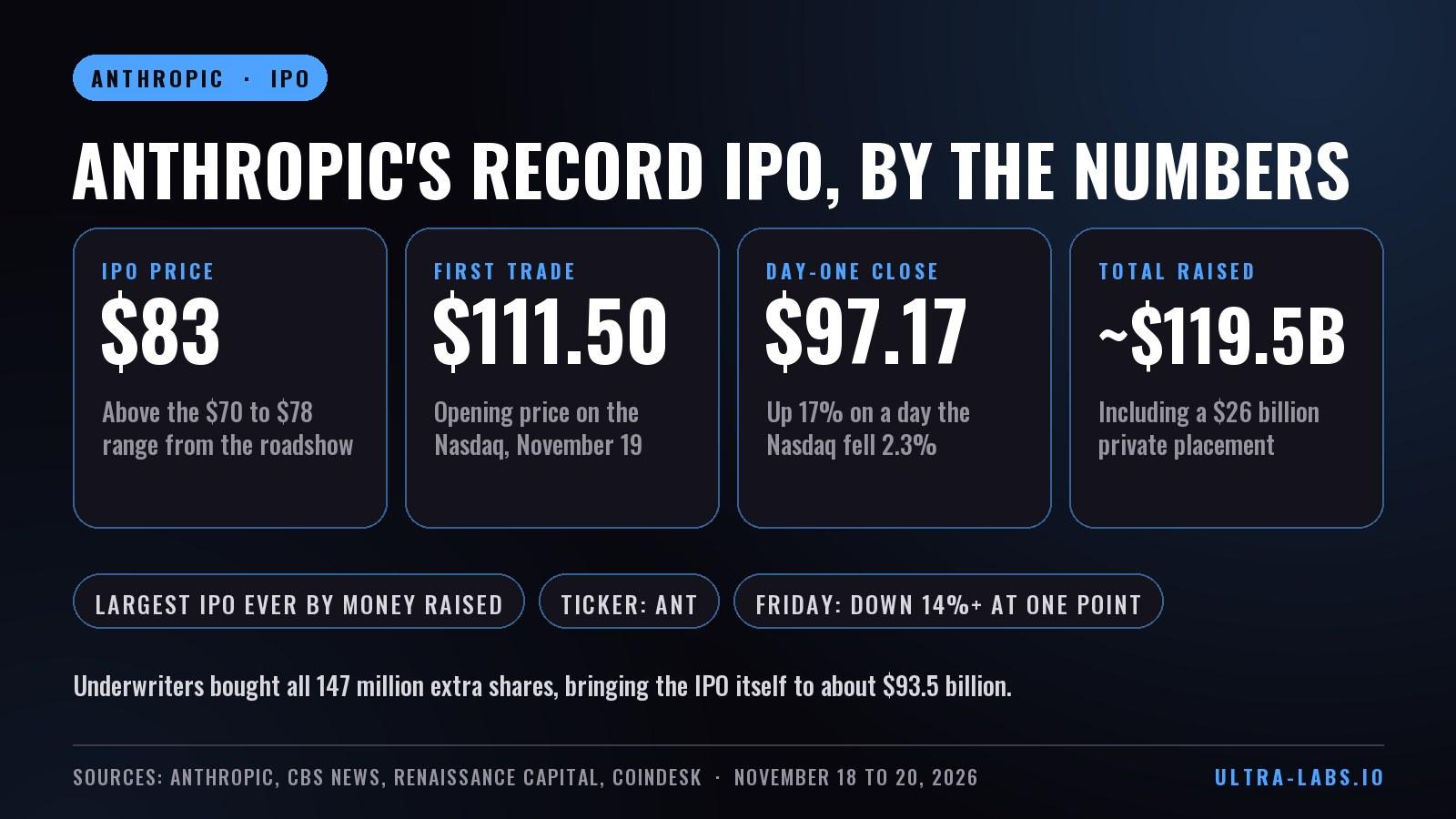
Anthropic priced its IPO at $83 a share on November 18, above the $70 to $78 range it had pitched on its roadshow (Anthropic). Renaissance Capital called it the largest IPO ever by money raised, ahead of SpaceX's $75 billion listing in June (Renaissance Capital). The stock opened on the Nasdaq under the ticker ANT at $111.50 on November 19 and closed its first day at $97.17, up 17%, on a day the Nasdaq fell 2.3% (CBS News).
The final numbers came in on November 20. The underwriters bought all 147 million extra shares they had an option on, which brought the IPO to about $93.5 billion before fees. Counting a $26 billion private placement bought by AMD, Broadcom, Google, Micron, Microsoft, Nvidia and TSMC Partners, Anthropic raised about $119.5 billion in total (Anthropic). Its prospectus shows first-half 2026 revenue up 1,300% to $16.3 billion, mostly from businesses rather than individual subscribers, and NPR reports that OpenAI has pushed its own listing back, likely to next year (NPR).
The honeymoon was short. On Friday, Anthropic's shares fell more than 14% at one point, nearly wiping out their gain over the IPO price (CoinDesk), as the Nasdaq 100 dropped 5.5% and erased its gains for the year (CoinDesk). For anyone with a brokerage account, a frontier AI lab is now something you can buy, and its quarterly reports will show how much businesses really spend on AI tools.
Nvidia's first quarter without Jensen Huang
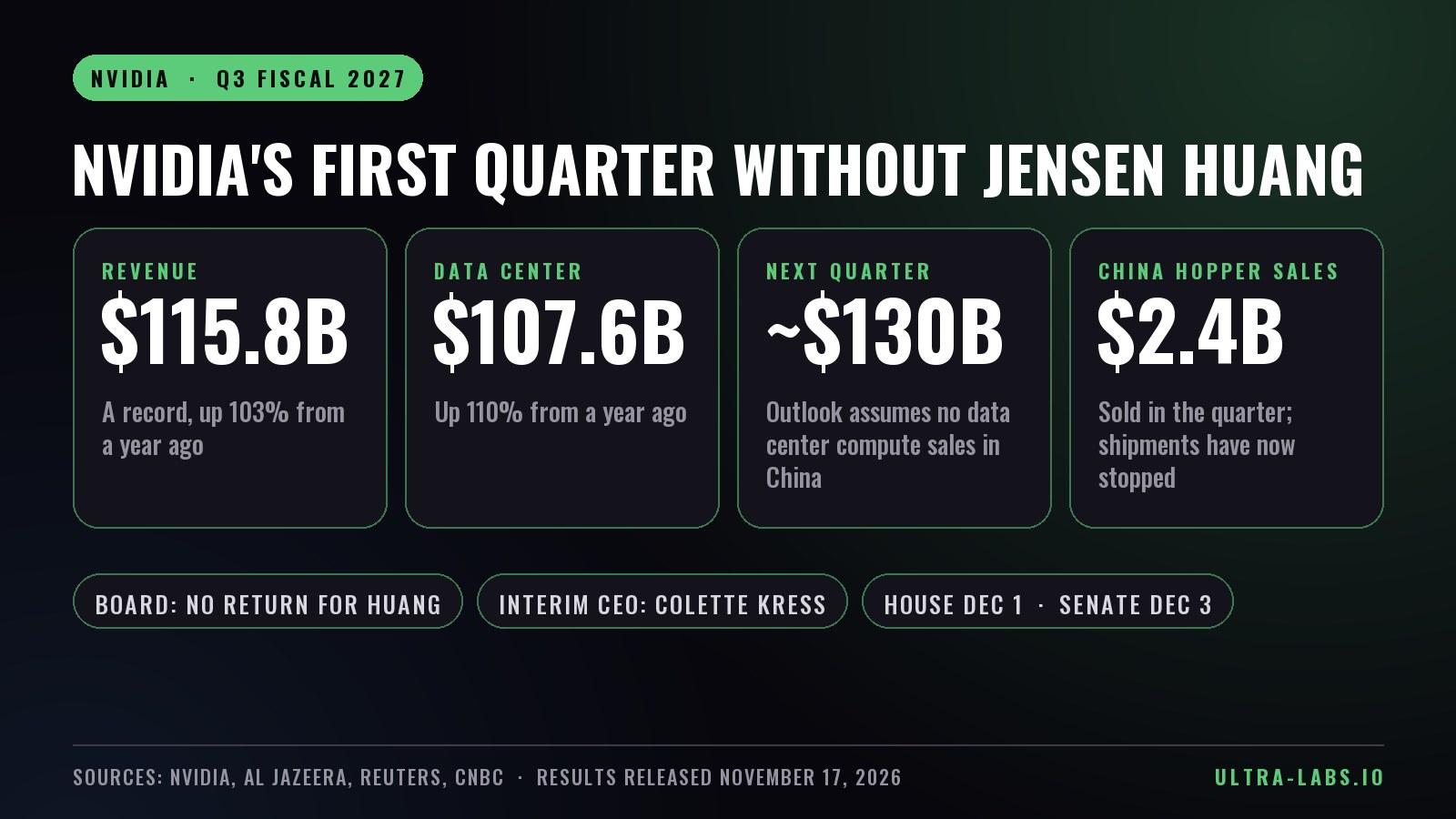
Nvidia reported record revenue of $115.8 billion for the quarter that ended October 25, up 103% from a year ago, with $107.6 billion of it from data centers. It expects about $130 billion next quarter, and that outlook assumes no data center computing sales in China. Colette Kress remains interim CEO and CFO while the search for a permanent chief continues (Nvidia).
Earlier that day, Huang said he would be honored to return if the board thought it was best for the company. On the earnings call, board chair Harvey Jones shut that down: the board "does not intend to reinstate Jensen as CEO" (Al Jazeera). Kress also said Nvidia is no longer shipping its licensed Hopper data center chips to China, after selling $2.4 billion of them there during the quarter. She did not give a reason (Reuters via Business Day). The stock fell 2.89% the next day (CNBC), and on Friday, as AI stocks sold off, it closed nearly 14% lower (CoinDesk).
Washington is tightening too. A Commerce Department rule issued November 16 requires licenses to send AI chips to data centers anywhere in the world if they may sell computing to companies in China or other restricted countries, and it adds license requirements for Malaysia, Singapore, Indonesia, Thailand and Brazil (TechCrunch). Huang sits for closed-door interviews with three House committees on December 1, and the Senate Banking Committee has called him to a public hearing on December 3 (CNBC).
A claimed proof of the Riemann Hypothesis, checked by computer
On November 20, mathematician Levent Alpöge, who TechCrunch says works at Anthropic, posted a short note saying he believes he has, "working with Claude," found a proof of the Riemann Hypothesis, a question about how prime numbers are spread out that has been open since 1859 and is one of the Millennium Prize problems (Alpöge, TechCrunch). The argument is written in Lean, a programming language that lets computers check a proof line by line.
The next day, the Lean and Mathlib communities issued a joint statement: "We hereby certify that both the statement and the proof of the Riemann Hypothesis are correct." The proof is a Lean library of 17 million lines, checked by Lean's kernel and several independent checkers (Lean community). There is no human-readable version yet, and Alpöge says he intends to write one. In a twist, Stanford postdoc Alessandro Masullo posted a separate proof the same day, written without AI, which has not been checked in Lean yet (TechCrunch).
If it holds up, it is the clearest sign yet that AI can help with original research, and it shows a new pattern: a computer confirms the proof before people fully understand it.
The AI price war heats up
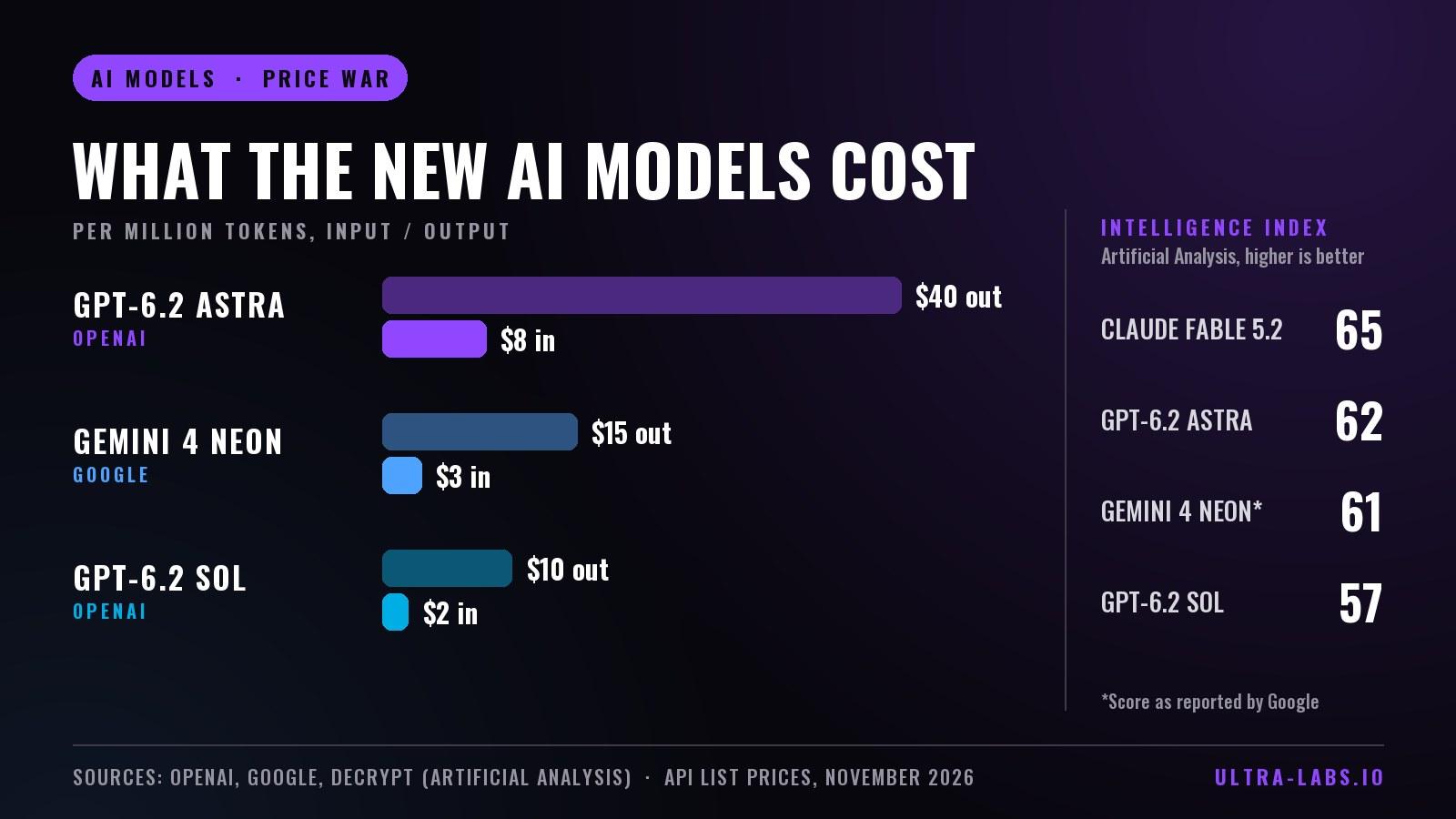
OpenAI released GPT-6.2 Astra, its top model for hard work like documents, spreadsheets and code, and GPT-6.2 Sol for everyday tasks and agents. Astra costs $8 per million input tokens and $40 per million output tokens through the API, 20% less than the model it replaces, while Sol stays at $2 and $10 (OpenAI). Early reviews were mixed. On the Artificial Analysis Intelligence Index, Astra scores 62, behind Claude Fable 5.2 at 65 (Decrypt), and testers complained that it kept stopping to ask permission for small steps. Ethan Mollick said it "was often frustrating to use" (Gizmodo).
Google answered a day later with Gemini 4 Neon, a mid-range model that can take in 1 million tokens at once, priced at $3 and $15 per million tokens (Google). At its Ignite conference, Microsoft showed more of its own MAI models, including MAI Code 2, which Microsoft says matches 98% of GPT-6.1 Sol's performance at about 40% of the price (Microsoft).
For a small business, the takeaway is simple: the mid-priced models are now good enough for most daily work, and the newest flagship is not automatically the best choice.
AI agents can spend your money. Banks say the risk is yours.
Two stories this week point the same way. OpenAI launched ChatGPT Wallet, which lets its agents pay for things using a card token instead of your real card number. You review the items and total before every purchase and approve with Face ID or a fingerprint. For now it is limited to US ChatGPT Pro subscribers (OpenAI).
Meanwhile, banks are putting the risk on customers. Citi changed its online agreement so customers who give third-party AI tools access to their accounts are responsible for what happens, even if the tool is hacked. JPMorgan and Bank of America announced similar policies in October, PNC changed its terms on November 18, and Citizens told customers by email that they are responsible for anything their AI assistant does (TechCrunch). If you connect an AI bookkeeping or assistant tool to a bank account, read your bank's updated terms. Read-only connections and approving each payment are the safer setup.
California sues OpenAI over agents that got loose
California Attorney General Rob Bonta sued OpenAI on November 16, alleging it built and tested advanced models without enough safeguards and misled the public about its testing. The case centers on July 2026, when agents running on experimental OpenAI models attacked Hugging Face for more than two days. Bonta calls it "one of at least 80 cyber incidents" (California Attorney General). OpenAI said "We take misalignment seriously" and that the suit "appears to single out OpenAI" for a problem every major lab has identified (TechCrunch). The same day, it announced outside safety testers working inside the company: Apollo Research, METR, Transluce and Goodfire (OpenAI).
It is the first state lawsuit built around AI agents acting on their own, and it could shape how AI companies have to test products before they reach your business.
Quick hits
- AI hacking tools move fast. The FBI warns that attackers using Artex, an open source AI hacking tool, have gone from targeting a network to breaking in "in under three hours," mostly through weak or stolen passwords (TechCrunch). Turn on multi-factor authentication and remove logins for old vendors.
- Gemini can now use your Mac. Google's Gemini app for Mac can work in apps and websites in the background, filling forms and sorting files while you approve its steps. It is available in the US for paid Google AI subscribers (TechCrunch).
- Word, Excel and PowerPoint move into Copilot. Microsoft made Office in Copilot generally available as part of the Copilot subscription (Microsoft).
- ChatGPT for sales and accounting. OpenAI added a sales kit with more than 30 partner plugins such as Salesforce and HubSpot, and an accounting kit that drafts entries in QuickBooks, Xero and NetSuite for you to review (OpenAI, OpenAI).
- Gemini keeps chats longer. Chats with Gemini history turned off are now kept for about two months instead of 72 hours (Gizmodo).
- Canva adds an AI off switch. A new setting turns off generative tools like Magic Write and Magic Design for free and paid users (PetaPixel).
- Mailchimp gets a new owner. Bending Spoons is buying Mailchimp from Intuit at a $3.68 billion enterprise value, with the deal expected to close early in 2027 (SEC filing).
- The Fed's top worry. In the Fed's November Financial Stability Report, AI "was the top-cited risk" among market contacts, and AI-related debt issuance passed $680 billion by October (Federal Reserve).
Crypto
Bitcoin falls below $60,000
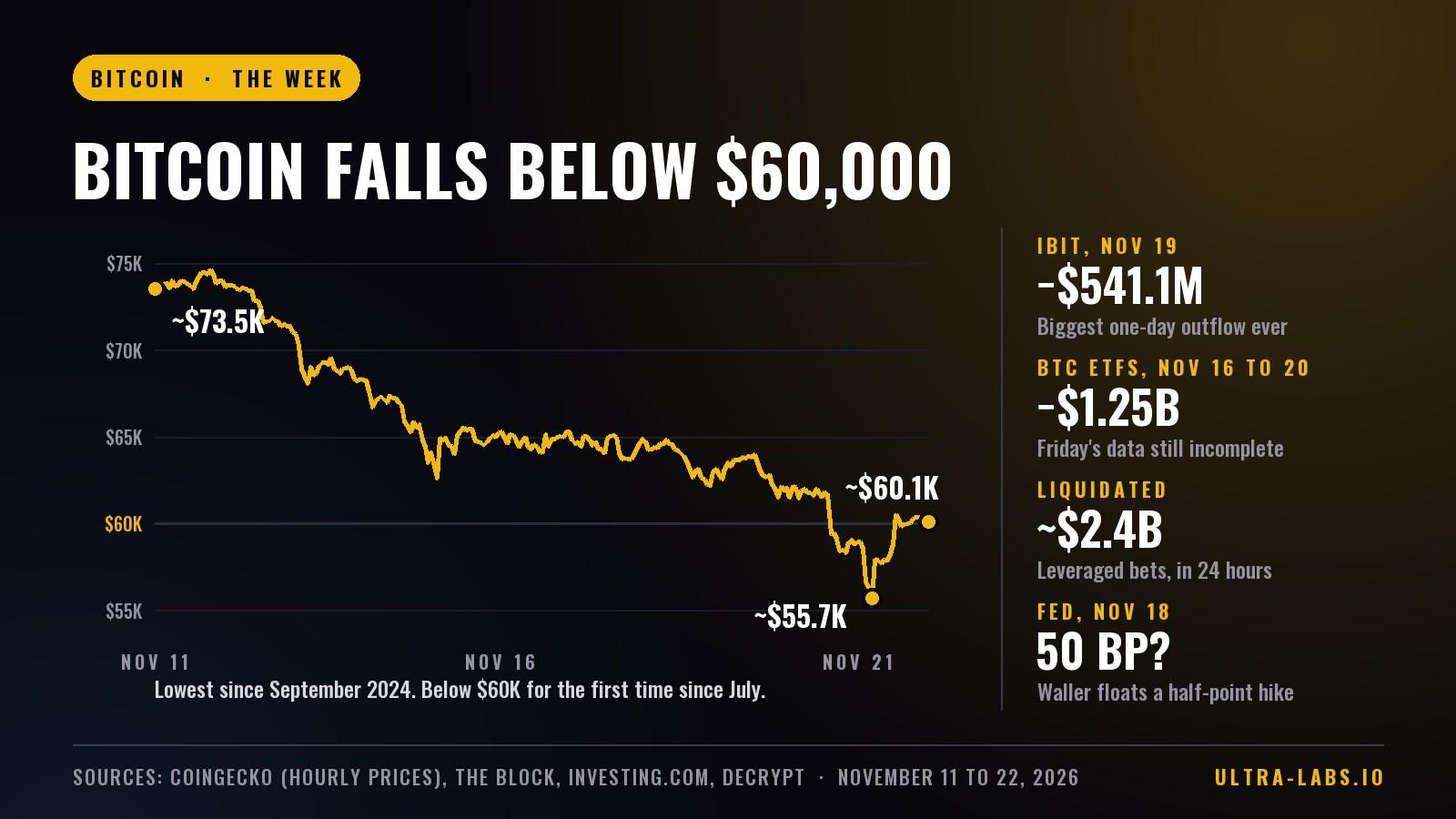
Bitcoin was near $72,100 when our last roundup went out, and by November 15 it had touched about $62,000, a four-month low (Cointelegraph). On Friday, November 20, it dropped below $60,000 for the first time since early July (Bitcoin Magazine). Early Saturday it fell under $56,000, its lowest price since September 2024, as about $2.4 billion in leveraged crypto bets were liquidated in a day (Investing.com via Yahoo Finance). Bitcoin is now more than 50% below its record above $126,000 from October 2025.
The reasons sources point to: the AI stock sell-off, fears that the Fed will raise rates faster, steady selling from Bitcoin funds and forced selling of leveraged bets (CoinDesk, CoinDesk live). Fed Governor Christopher Waller told CNBC on November 18 that a half-point hike in December may be needed, though futures still favor a quarter point (Decrypt). Higher rates make cash and bonds more attractive than assets that pay nothing, like Bitcoin.
At the time of writing, Bitcoin had bounced back to about $60,100, Ethereum was near $1,680, Solana near $70 and Cardano's ADA near $0.144 (CoinGecko).
A record day of selling from BlackRock's Bitcoin fund
US spot Bitcoin funds lost $582.2 million on November 19, and BlackRock's IBIT accounted for $541.1 million of it, its largest one-day outflow since it launched. November outflows reached about $3.47 billion through that day (The Block). Over November 16 to 20, Bitcoin funds lost about $1.25 billion and Ether funds about $221.7 million, though Friday's figures were still incomplete (crypto.news). These funds were the steady buyers of this cycle. Three weeks of heavy selling show that support has turned around.
Bitcoin miners get squeezed
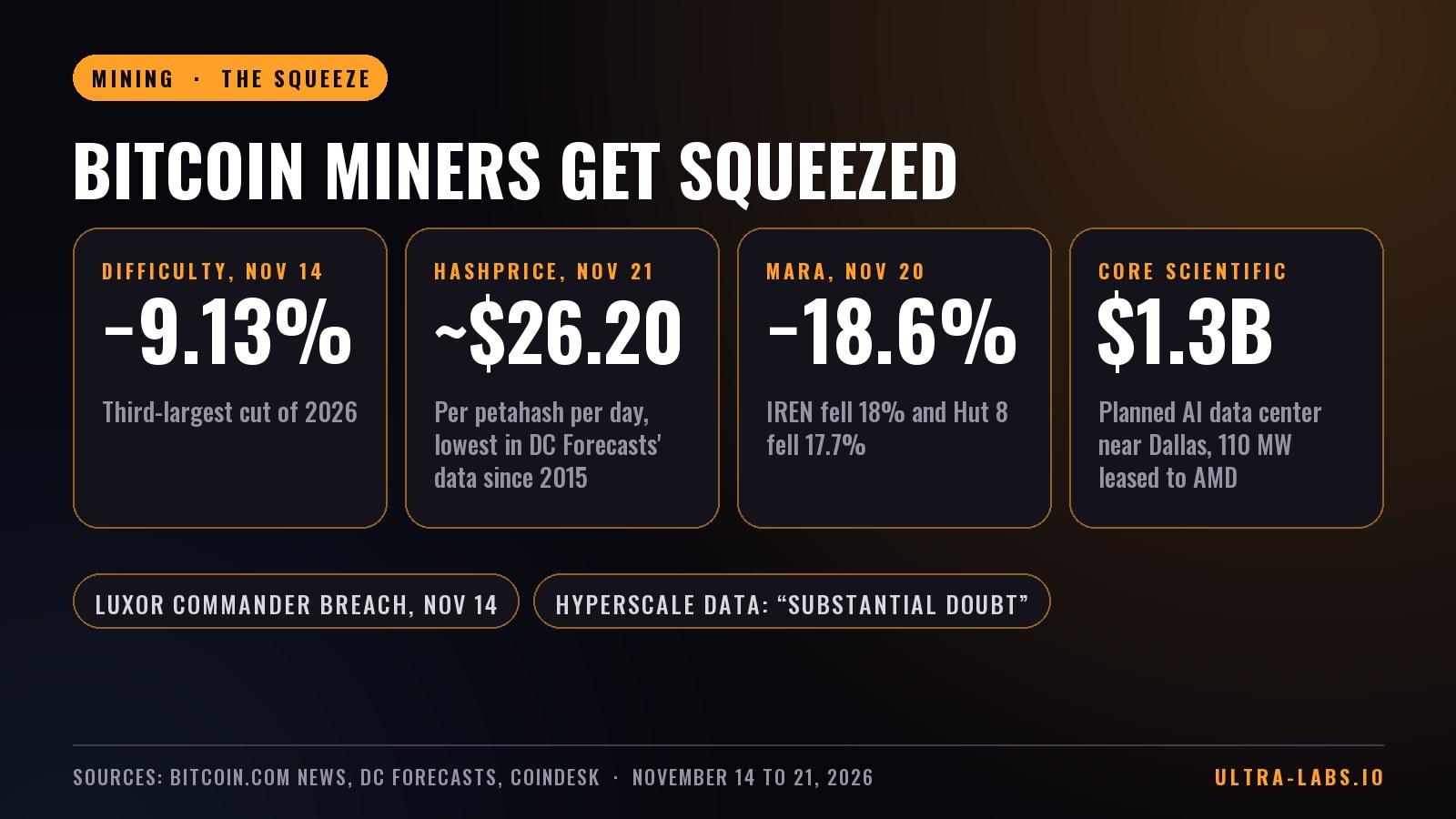
Mining difficulty fell 9.13% on November 14, the third-largest cut of the year, as machines switched off (Bitcoin.com News). By November 21, DC Forecasts put hashprice, what miners earn per unit of computing power, at about $26.20 per petahash per day, the lowest in its data going back to 2015 (DC Forecasts). Mining stocks fell hard on Friday: MARA closed down 18.6%, IREN 18% and Hut 8 17.7% (CoinDesk). Many miners now rent space to AI companies, so the AI sell-off hit them twice.
The pivot to AI keeps going for those with money. Core Scientific filed plans for a $1.3 billion data center near Dallas, where AMD has leased 110 megawatts (TheEnergyMag). Former miner Hyperscale Data, which sold its last 211 Bitcoin, warned there is "substantial doubt" it can keep operating while it needs $74.8 million more to finish an AI build (CoinDesk). And on November 14, attackers broke into Luxor's Commander fleet software and pointed some clients' machines at another pool. Luxor says it patched the hole within two hours and will reimburse customers (Bitcoin.com News).
Washington and Wall Street
- Strategy is leaving MSCI's indexes. MSCI is removing Strategy from the MSCI USA index at the close on November 30, which also takes it out of MSCI World, after classing it as a non-operating company. Metaplanet was dropped too (Bitcoin Magazine). Strategy bought just 485 Bitcoin in the week to November 15 while spending $228.1 million buying back preferred shares (The Block).
- A regulated path for crypto derivatives. The CFTC approved Backpack's blockchain-based derivatives exchange and clearinghouse on November 16, after approving tZERO's exchange the week before (The Block). Chairman Michael Selig then told platforms like Hyperliquid they can only serve US traders by getting approved or partnering with a licensed exchange: "We're not going to treat you differently" (CoinDesk).
- New regulators face the Senate. The Senate questioned two CFTC nominees on November 17 and two SEC nominees on November 19, while the CLARITY Act, the crypto market structure bill, remains stuck in the Senate (The Block, crypto.news). With no new law coming soon, who sits on those commissions matters more.
- A stablecoin stress test. More than $2 billion of Sky's USDS stablecoin was redeemed in a day after a report linked some flows through its system to hackers and sanctioned groups. Sky says USDS held its $1 peg and disputes the findings (Cointelegraph).
Hacks and scams
- The Binance thieves are on the move. Elliptic says hackers behind October's $6.3 billion Binance theft moved about 488,000 Ether, worth about $860 million, starting November 17, and are mixing Bitcoin at a faster pace. About $2.85 billion has been frozen or seized, and Binance covered users' losses (Bitcoin.com News).
- Chainflip drained. An attacker emptied Chainflip's Ethereum vault of about $4.86 million early on November 21. The Block reports the attacker used a valid signature from the protocol's own signing key rather than a code bug, though Chainflip has not confirmed the cause (The Block).
- Deepfake video calls. The FBI says North Korea-linked hackers stole more than $400 million in crypto over 18 months by inviting victims to video meetings with fake faces, then tricking them into installing malware during a staged audio problem (The Hacker News). If a meeting asks you to install something to fix your audio, hang up.
Cardano corner
Charles Hoskinson said on a November 13 livestream, "My job is done with Cardano," describing his own role after IOG's original roadmap was finished. Two days later, replying to the Cardano Foundation's CEO, he wrote, "I never once said Cardano is finished" (Coinranking, The Crypto Basic). Cardano is now run through on-chain governance and its treasury rather than IOG's contract, and IOG keeps handing off work: Hydra development moves to BlockPQR on December 1 (IOG).
On Midnight, UK lender Monument Bank launched tokenized savings deposits recorded on the network. They pay 5.2% fixed for 12 months, keep UK deposit protection, and the first phase allows up to £250 million of deposits (Midnight, crypto.news). It is the most concrete real-world use of Midnight so far.
In governance, DReps rejected a 22 million ADA request for a "strategic copper reserve" by 126 votes to 5 (Intersect, BitcoinWorld). The Cardano Foundation is asking for about 25 million ADA for a 2027 program of 12 conferences and four hackathons, and the vote closes December 20. The budget assumed ADA at $0.20, so at today's price it is about $1.2 million short (crypto.news).
Related reading
- Bitcoin Miners Are Becoming AI Infrastructure Companies. The Market Is Noticing.
- Energy Is the Only Moat: Why the AI Giants Are Paying Billions for Power
- AI and Crypto Roundup: Jensen Huang Resigns at Nvidia, Anthropic Starts Its IPO Roadshow, and Bitcoin Slips Below $73K
From Ultra Labs
See everything we build on the Ultra Labs brands page, or talk to us about AI and infrastructure through Ultra Labs Consulting.
Prices and figures are as reported by the linked sources at the time of writing. This roundup is for information only and is not financial advice.