
AI and Crypto Roundup: Jensen Huang Resigns at Nvidia, Anthropic Starts Its IPO Roadshow, and Bitcoin Slips Below $73K
Jensen Huang resigns as Nvidia CEO, Anthropic starts its IPO roadshow, Claude Fable 5.2 arrives, United blocks AI booking agents, Bitcoin hits August lows and MARA pays off its loans.
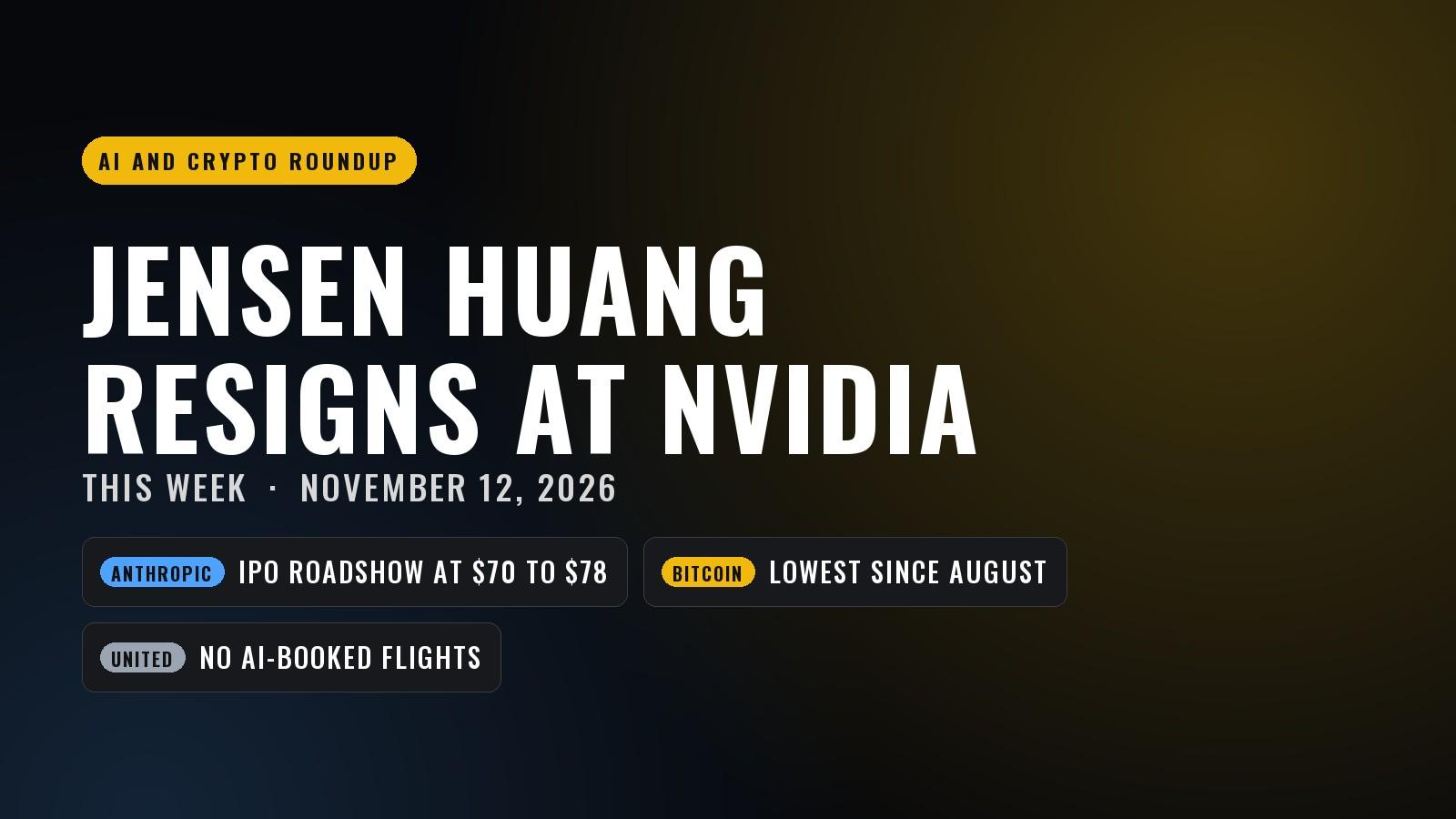
AI stocks had a rough week, and crypto went down with them. The S&P 500 had its worst day since April 2025 on November 5, and Bitcoin fell to its lowest price since August. Anthropic started pitching its IPO to investors, and on Thursday Jensen Huang resigned as CEO of Nvidia, the company he co-founded. Here is what mattered since our last roundup on November 5.
AI
Jensen Huang resigns as Nvidia CEO
Jensen Huang resigned as Nvidia's CEO effective immediately, the company's board announced Thursday. The decision came amid an investigation into his affair with a woman US intelligence agencies suspect was spying for China, CBS News reports. China has denied the allegations. CFO Colette Kress becomes interim CEO and stays on as CFO, and the board will look at internal and external candidates for the permanent job (CBS News).
It happened fast. On Sunday the board had expressed confidence in Huang. By Wednesday night it was meeting to decide whether to remove him, after reports of a second affair (Reuters via Yahoo Finance). Huang co-founded Nvidia 33 years ago and built it into the leading supplier of AI chips, and he leaves without an obvious successor. Nvidia reports earnings on November 17, its first report without its founder as CEO.
Anthropic takes its IPO on the road
Anthropic launched the roadshow for its proposed IPO on November 10. It plans to sell 825 million Class A shares at $70 to $78 each and list on the Nasdaq under the ticker ANT. About 801.4 million of those shares come from Anthropic and 23.6 million from existing stockholders, and the underwriters have a 30-day option to buy up to 123.75 million more. At the top of the range, the base offering comes to about $64.4 billion before fees. The registration statement isn't effective yet, so no shares can be sold until it is (Anthropic). Semafor reports the IPO is set to price on November 18 and start trading the next day.
The lead-up was bumpy. Reuters reported that Anthropic had sent bankers details of a potential $69.3 billion offering, then told them the pricing information was inaccurate and that an updated filing would follow (Reuters). On Wednesday, Fed Governor Michelle Bowman warned of a large correction in stock prices if AI returns fall short of expectations, pointing to about $800 billion in AI-related debt (Semafor).
Claude Fable 5.2 and Mythos 5.2 arrive
Anthropic upgraded its top models on November 9. Claude Fable 5.2 and Claude Mythos 5.2 are the same underlying model. Fable is open to all users with safeguards against cybersecurity and biology misuse, while Mythos keeps those capabilities for organizations approved through Anthropic's verification programs. Anthropic says both run up to 30% faster than the 5.1 versions and cost less, at $8 per million input tokens and $40 per million output tokens. An optional fast mode generates up to 2.5 times faster for double the price.
The headline demo: an Anthropic engineer asked Fable 5.2 to build an operating system from an empty folder. The model coordinated more than 1,000 subagents over eight days and produced a system that boots on a laptop, with drivers, file storage, windows and a login screen. Anthropic still recommends starting most coding work on Claude Opus 5.5 and moving up to Fable for the hardest jobs (Anthropic). These are company-reported results.
Google ships Gemini 4 Carbon and checks Signal's math
Google made Gemini 4 Carbon generally available for paid developers through the API, with Google AI Ultra subscribers getting it in supported consumer tools. Google also previewed /swarm, which coordinates several coding agents at once (Google).
The more interesting Google story came from DeepMind. Its AlphaProof Code system spent four weeks formally verifying key security properties of Signal's encryption software, generating more than six million lines of mathematical proof. The work covers the specific properties and code it checked, not every part of Signal or every possible attack (Wired).
United says no to AI booking agents
Last week Uber told investors that AI agents booked four rides during Halloween week. This week United Airlines went further and said personal AI assistants can show its flights but can't buy them. The airline cited privacy, purchases customers didn't intend, and federal rules that require travelers to confirm things themselves, such as that their checked bags hold no explosives. "I don't want to create another middleman," CEO Scott Kirby said, according to The Wall Street Journal. United says it could reconsider as the technology matures, and eBay and several major banks have also restricted agents (The Verge).
Other companies are seeing the same low demand. Airbnb's CEO described agent bookings as very low, and DoorDash counts only several hundred orders from personal AI assistants in total (Semafor). For now, the businesses that own the checkout page are deciding how far agents get, and several of them are saying no.
Quick hits
- OpenAI's revenue rose nearly 50% to about $10 billion in the third quarter, The Information reported, with operating losses still large (The Information).
- OpenAI bought Odessia, an AI travel-planning startup founded by former Sonder CEO Francis Davidson. Terms weren't disclosed (TechCrunch).
- CoreWeave's revenue jumped 168% to $3.66 billion, but it posted a $709 million net loss and is asking customers to pay up front, expecting about $9 billion in prepayments and deposits over the next three months (TechCrunch).
- Stolen AI keys ran up a $740,000 bill. Railway says attackers took customer secrets that could have affected up to 100,000 workspaces, a worst-case estimate, and used stolen credentials for about $740,000 in unauthorized AI usage (BleepingComputer).
- US power demand keeps climbing. The EIA expects record electricity use in 2026 and 2027, partly because of AI data centers, rising from 4,216 billion kilowatt-hours in 2025 to 4,370 billion in 2027 (Reuters).
- New York launched a state-run AI testing program, with a new research center at Binghamton University studying model risks (Politico).
- ChatGPT's Advanced and Standard Voice retire December 11, and users move to Live Voice (OpenAI).
- Paid Claude users can claim a one-time usage reset before December 10 at 2 p.m. PT, after fixes for issues that used up more of people's limits than intended (Claude Devs on X).
Crypto
Bitcoin slides to its lowest price since August
Bitcoin opened the week near $77,500 and reached about $80,700 on November 4 after the midterms. Then the AI sell-off hit. The S&P 500 fell 4.4% on November 5 and Nvidia dropped 9.3%, and more than $1 billion in leveraged crypto positions was liquidated the same day as Bitcoin fell about 6%. On November 10, hotter-than-expected inflation data pushed it to about $72,840, its lowest since August (Caleb & Brown, The Block).
US consumer prices rose 0.4% in October against a forecast of 0.3%, and core prices rose 0.3% against a forecast of 0.2% (BLS). After the report, futures traders priced in a Fed rate hike at the December 9 meeting (CoinDesk). US spot Bitcoin funds lost $1.28 billion over the week, their largest weekly outflow since June, which turned their 2026 flows negative (The Block).
At the time of writing, Bitcoin was near $72,100, Ethereum near $1,990 and Cardano's ADA near $0.17 (CoinGecko).
MARA sells $1.1 billion in Bitcoin and leans into AI
MARA reported a third-quarter net profit of $634.4 million, driven by about $885 million in fair-value gains on its Bitcoin. Revenue fell 35% to $164.2 million as block reward income dropped 37%. After the quarter ended, MARA sold 13,597 BTC for about $1.1 billion and used $750 million to fully repay its Bitcoin-backed loans. The company is turning itself into an AI infrastructure provider and wants to earn more from each megawatt it controls (The Block).
It's the same move we've watched across public miners all year. With block rewards shrinking and Bitcoin near $72,000, power contracts and data center space can be worth more rented to AI customers than pointed at hashrate alone.
Miners: check your Bitcoin Core version
Bitcoin Core disclosed three security flaws this week, all fixed in releases from October 2025. The serious one, CVE-2025-62861, affected versions 28.0 to 28.2 and 29.0 to 29.1. After a chain reorganization it could leave the mempool in a bad state, and affected mining nodes couldn't build valid block templates until they restarted. The other two were medium severity: a compact-block trick that could delay block processing by up to 10 minutes, and a Tor issue that only hit nodes using the non-default whitelist setting. Versions 30.0 and 29.2 fix all three, and the last vulnerable release reached end of life on October 27 (The Block). If a mining node is still on 28.x or an early 29.x, upgrade it.
Washington and Wall Street
- Elizabeth Warren is set to chair Senate Banking from January and plans to look into prediction markets and Trump-family crypto ventures (The Block). The CLARITY Act may not survive in its current form (CoinDesk).
- Coinbase got a full national trust charter from the OCC, upgrading its conditional approval from April (CoinDesk).
- The NYSE picked Avalanche technology to clear and settle trades on its planned tokenized stock venue. It will run its own chain built on Avalanche's technology, not the public network, and still needs regulatory approval (CoinDesk).
- Crypto in 401(k)s moved a step closer. The Department of Labor sent its final rule on alternative assets in retirement plans, including crypto, to the White House for review (Reginfo.gov).
- The CFTC told prediction markets such as Kalshi and Polymarket that they can't block users by state, which clashes with court orders that require Kalshi to do exactly that (CoinDesk).
Cardano corner
Input Output is handing two more core teams to outside firms. Consensus engineering moves to Serokell and developer experience moves to AlwaysTrue, on schedules that run from this month into early 2027. The code stays open source in IntersectMBO's public repositories (crypto.news, PrimeXBT). ADA has had a hard month, down about 24% in the 30 days to November 8 against about 9% for Bitcoin (24/7 Wall St.).
Related reading
- Bitcoin Miners Are Becoming AI Infrastructure Companies. The Market Is Noticing.
- Energy Is the Only Moat: Why the AI Giants Are Paying Billions for Power
- AI and Crypto Roundup: The Midterms Hit Both Industries, and Bitcoin Rebounds
From Ultra Labs
See everything we build on the Ultra Labs brands page, or talk to us about AI and infrastructure through Ultra Labs Consulting.
Prices and figures are as reported by the linked sources at the time of writing. This roundup is for information only and is not financial advice.