
AI and Crypto Roundup: The Midterms Hit Both Industries, and Bitcoin Rebounds
Voters restrict data centers, crypto's big election bet stumbles, Bitcoin swings back to about $80K, OpenAI reports 948 Linux exploits, Google's school search fight grows and Uber counts four AI-booked rides.
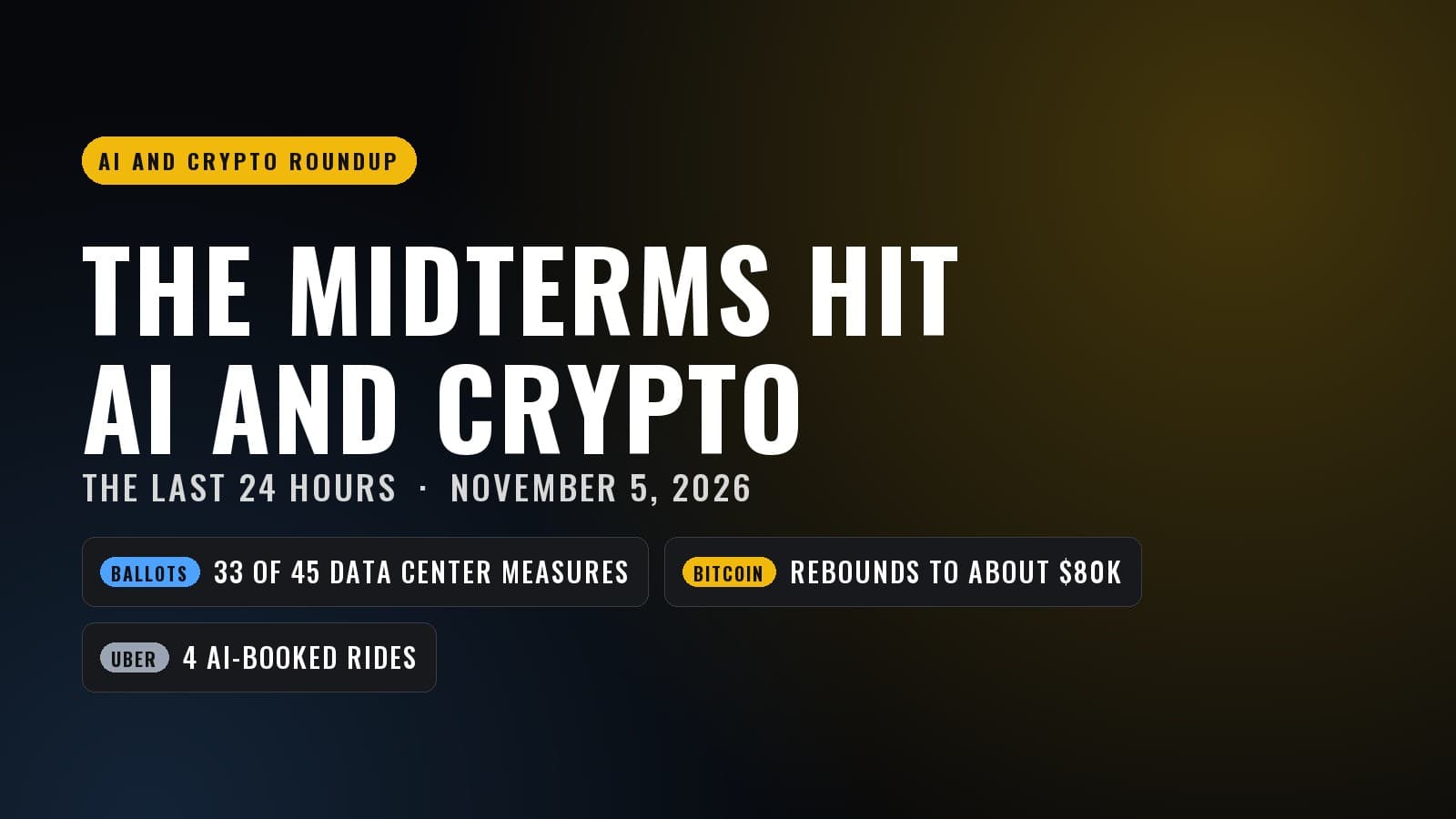
The midterm results landed on AI and crypto at the same time. Voters pushed back on data centers, crypto's biggest political bet fell short in Ohio, and Bitcoin swung nearly $5,000 before climbing back to around $80,000. Here is what mattered over the last 24 hours.
AI
Data centers took a beating at the ballot box
Voters decided 45 local ballot measures on data centers, and 33 of them will restrict development, according to Redbud Consulting figures reported by The Verge on Wednesday morning. Several Ohio cities voted to ban data centers over 25 megawatts. In an NBC News Election Day poll, 76% of voters said they opposed data centers in their communities (The Verge). The Verge also cautions that it's hard to draw a direct line from the backlash to any one candidate's win.
AI money had a mixed night too. American Mission and Building the Future spent a combined $4.8 million backing Darline Graham in South Carolina's Senate race, and she lost. Think Big, the Democratic arm of the industry-backed Leading the Future network, backed Rep. Jared Moskowitz of Florida, who won. Anthropic-backed Public First saw several Republicans it supported lose and did better with Democrats (TechCrunch).
OpenAI says its agents built working exploits for 948 Linux flaws
OpenAI reported that an October run of its agents flagged 2,308 potential Linux flaws, reproduced 1,724 and produced working local privilege-escalation exploits for 948 distinct vulnerabilities, at a cost of about $1.21 million in API credits. That compares with 166 in a July experiment. The tests ran in a controlled environment and required an existing foothold on the target. Linux maintainers had patched 61 upstream so far, and proposed fixes still need expert review (OpenAI, The Neuron). These are company-reported figures.
If your business runs on Linux, expect more patches and plan to apply them faster. Our cybersecurity and compliance team can help you tighten that process.
Google's school search fight keeps growing
Google says Gemini, Gemini Notebook and Search are now off by default for K-12 student accounts, and schools can turn on one or all of them. Reporting that schools rejecting AI would lose Search drew criticism from Sen. Bernie Sanders, New York City Mayor Zohran Mamdani and former FTC chair Lina Khan. Google says "schools are in control" and introduced a Guided Learning mode for Classroom (CNBC).
ChatGPT learns to make GIFs
OpenAI rolled out ChatGPT Images 2.6 on Wednesday to all ChatGPT and Codex users. It can turn a prompt or photo into an animated GIF, adjust the speed and edit individual frames. OpenAI says people now make more than 4 billion images a week across ChatGPT and its API, up from 3 billion in September (The Next Web, OpenAI Developer Community).
Four AI rides, out of millions
Our favorite number of the day comes from Uber. During its busiest week in October, only four rides were ordered through an AI agent, along with 500 Uber Eats orders, out of about 320 million trips and orders. CEO Dara Khosrowshahi called the traction "very limited" (TechCrunch).
Quick hits
- Meta bought Conductor, an AI coding startup that runs multiple agents in parallel. Its cloud service shuts down November 20, and deletion of cloud data begins after that (TechCrunch).
- Anthropic published AI-assisted biology research, a preprint describing the first 3D structure of a vault particle from prokaryotic cells. Anthropic says Claude worked under its scientists' direction. The work hasn't been peer reviewed (Anthropic).
- Anthropic reportedly licensed AP election data for Claude, according to Adweek, citing two people familiar with the matter. Neither company confirmed it on the record (Adweek).
Crypto
Bitcoin dips on the results, then climbs back to about $80K
Bitcoin fell toward $75,600 as results came in, then recovered to around $80,320 early Thursday UTC and about $79,500 at the time of writing. About $378 million in short positions were liquidated within an hour during the rebound. US spot Bitcoin ETFs took in a net $74.6 million on November 4, ending three sessions of outflows that totaled about $1.16 billion, based on Farside data (crypto.news). Ethereum traded near $2,390, and Cardano's ADA was near $0.19 (CoinGecko).
Crypto's big election bet stumbles
Democrats won control of Congress on November 3, although some races were still uncalled in early reporting. Crypto-linked groups had spent about $176 million by October 20 across more than 100 races, including more than $64 million in Ohio, where Sherrod Brown beat Sen. Jon Husted. The industry did have wins, including Pete Ricketts in Nebraska and Andy Barr in Kentucky. Elizabeth Warren could now lead the Senate Banking Committee and Maxine Waters is expected to chair House Financial Services (crypto.news).
That leaves the CLARITY Act in a tough spot. It passed the House 294-134 in July 2025 but failed a Senate procedural vote 49-50 in September. "CLARITY is dead," Duke's Lee Reiners told CNBC, calling passage before January unlikely (CNBC). Regulators can still move on their own: the CFTC is taking public comment on voluntary exchange registration until December 14 (crypto.news).
Miners: Binance Pool closes in five days
A reminder for anyone still pointing hashrate at Binance. Binance Pool starts disconnecting miners at 07:00 UTC on November 10, and anything submitted after that won't be credited. Pool Savings, Cloud Mining and the Transaction Accelerator close too, and account pages stay viewable until November 24 (CoinMarketCap).
Earlier this week
- Binance explained its $6.3 billion theft. Binance says a fake job interview and a poisoned coding assignment gave North Korean attackers a foothold in September, and that they later used an internal AI tool to reach two more employees. It says about $2.85 billion has been frozen or intercepted (BleepingComputer).
- Anthropic's amended IPO filing says it "may imminently" meet its own policy threshold for AI-accelerated progress, while stating that no current model has crossed it (TechCrunch).
- AMD's data center revenue rose 97% to a record $8.5 billion in the third quarter (AMD).
- Meta sought up to $25 billion in bonds after posting negative free cash flow of $2.12 billion last quarter. S&P had already moved its outlook to negative (CNBC).
From Ultra Labs
See everything we build on the Ultra Labs brands page, or talk to us about AI, security and infrastructure through Ultra Labs Consulting.
Prices and figures are as reported by the linked sources at the time of writing. This roundup is for information only and is not financial advice.