
Cybersecurity Roundup: A Record Year for Hacks, a Week of Outages, and AI Attacks in Under Three Hours
Software flaws pass 100,000 for the year, ransomware gangs beat 2025's total, vendor hacks hit Expedia, Chase, Visa and Mastercard, a run of outages takes down Microsoft 365 and US flights, and the FBI warns about an AI hacking tool.

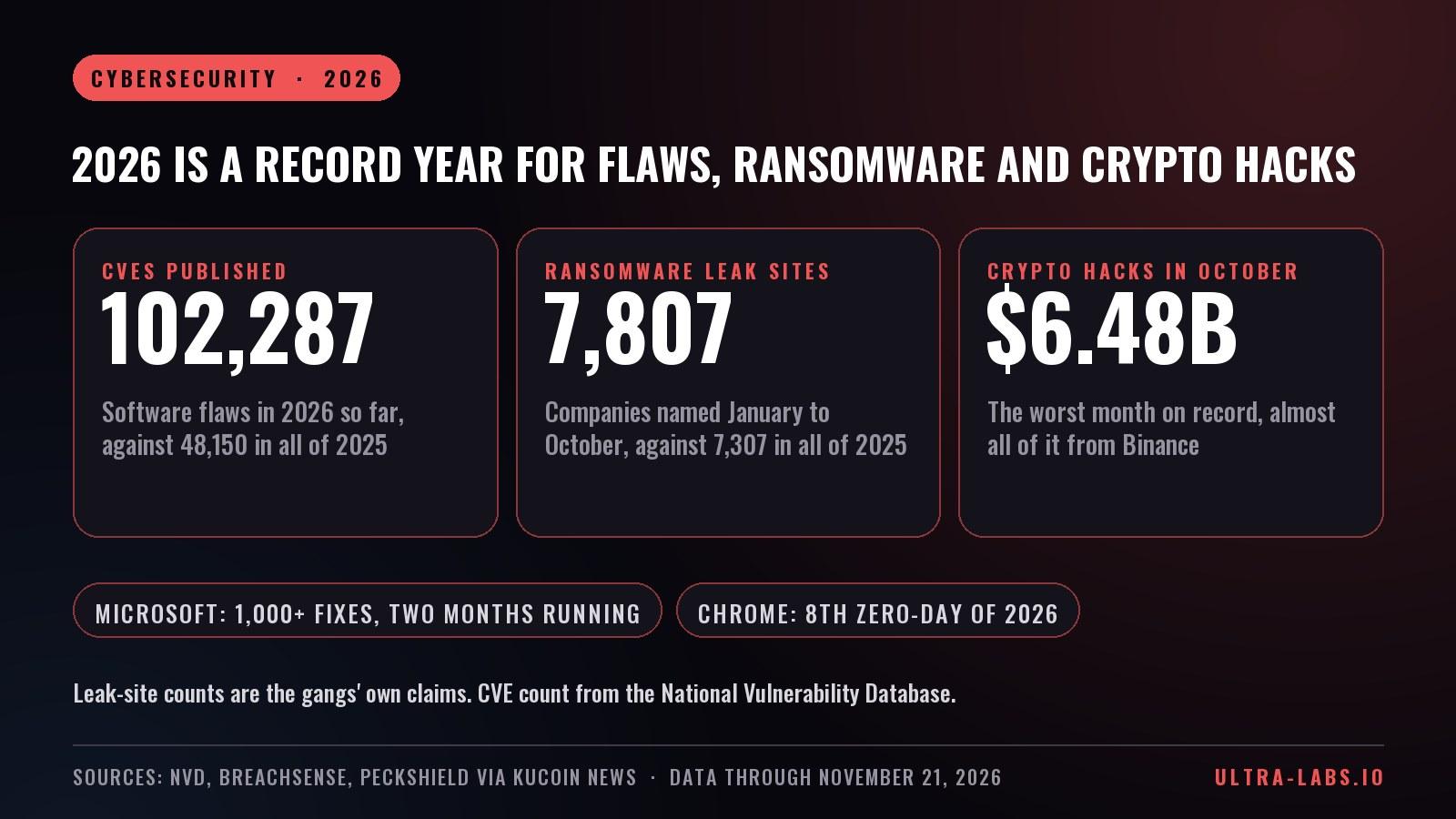
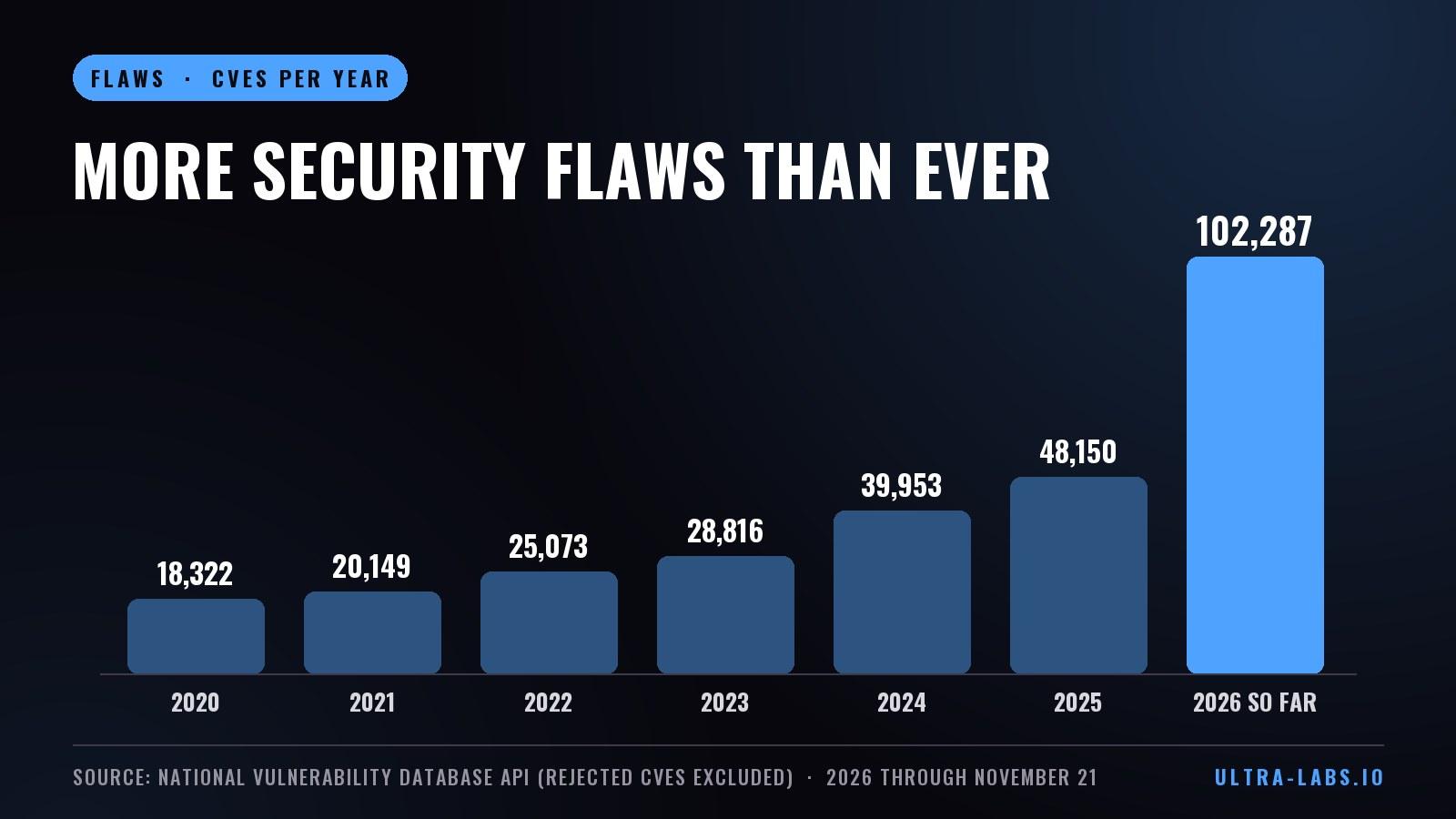
If it feels like something new breaks every day, the numbers agree. More than 102,000 software flaws have been published so far in 2026, more than double all of last year. Ransomware gangs have already named more victims on their leak sites than in all of 2025. October was the worst month for crypto hacks on record. And in the space of one week this month, Microsoft 365, the FAA, Chase, United and Apple all went down, one after another. Here is what happened in cybersecurity from November 8 to 22, and what to do about it.
The breaches
One gang, a lot of big names
A group calling itself n0n, believed to be based in Russia, is behind several of the fortnight's biggest claims. It first appeared in September and posted 108 victims in its first month (The Register). Its pattern is to hit the vendors big companies use, not the companies themselves.
On November 12, Expedia, which also runs Hotels.com and Vrbo, confirmed that attackers reached its systems through a compromised third-party data platform it has not named. "We are aware of a supply chain attack, reported by security researchers," the company said, adding that its platforms "are safe to use for both travelers and partners" (Skift). n0n claims it took close to a billion records, including hundreds of millions of loyalty program entries. Expedia has not given a number, and the gang's claim has not been verified (KVLY).
On November 19, JPMorgan Chase, Visa and Mastercard each confirmed that vendors had been hacked after n0n listed all three on its leak site. Chase said the attackers "accessed certain marketing data held by those vendors," which "may include some customer names and email addresses," and that it would offer free credit monitoring where appropriate. Visa said no card numbers were affected and its own systems were not involved. Mastercard said a "limited amount of email addresses" from cardholders in one benefit program were exposed (ABC News, The Register). None of the three gave a count. If you bank with Chase, expect phishing emails that use this news as bait.
Malware served from the BBC, CNN and Zoom
On Sunday, November 16, an attacker abused a flaw in the signup process for Optimizely, a tool that big websites use to test page designs, and slipped malicious code into customer projects. Because Optimizely's code loads on its clients' pages, the malware ran on sites including Zoom, the BBC, CNN, Salesforce, GitLab and KLM (BleepingComputer). Security researcher Scott Helme found 188 infected scripts belonging to 178 organizations. The code swapped crypto wallet addresses, skimmed card details typed into sites' own payment forms, and pushed exploit kits at older iPhones and iPads. It was cleaned up by late that night (Report URI).
If you sent crypto or paid by card on a big brand's website on November 16, check your statements, and update your iPhone or iPad if you haven't lately.
Japan's two giant leaks
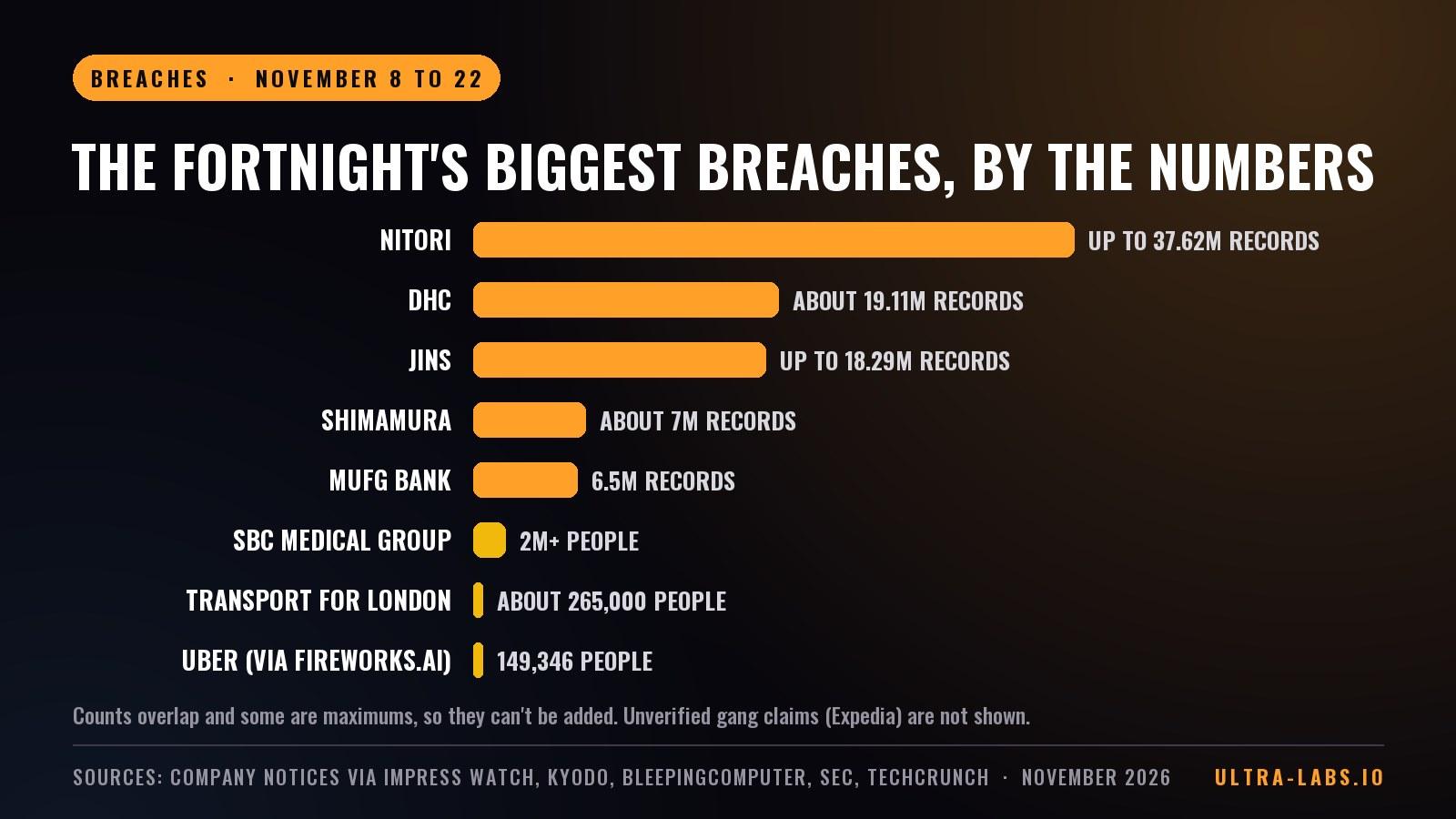
Japanese furniture chain Nitori said on November 9 that "up to 37.62 million records of personal information" may have been stolen, including names, addresses, phone numbers and order history. It says passwords and card data were not included (BleepingComputer, Impress Watch).
Days later, one hack of KARTE, a marketing platform run by the Japanese company PLAID (not the US fintech Plaid), spilled customer data from many brands. An attacker exploited a server flaw on November 13, stole credentials and pulled data through the admin console (PLAID). Cosmetics maker DHC reported about 19.11 million records, eyewear chain JINS up to about 18.29 million, clothing chain Shimamura about 7 million and MUFG Bank 6.5 million (Impress Watch, Kyodo). These counts overlap, so they can't be added up.
Universities, AI vendors and everyone else
Vanderbilt University told staff and students on November 9 to shut down university devices and stay off campus Wi-Fi during an "active cybersecurity incident." All users had to reset passwords, and OneDrive, SharePoint and Teams were still off on November 19, with a target of early December (Vanderbilt). A ransomware group called BYOD claims it took more than a million Social Security numbers. The university has not confirmed any data theft (BleepingComputer).
Uber said hackers stole names, addresses, dates of birth and driver's license numbers for 149,346 people from Fireworks.ai, an AI company it works with. Because the attackers used Fireworks' own credentials, "no alerts were triggered," Uber said. Fireworks blamed a group that sells stolen access to AI models, and Notion and Cursor also confirmed data was taken in the same hack (TechCrunch, SecurityWeek).
Quick hits:
- Transport for London said about 265,000 Oyster photocard holders may have had names, addresses, dates of birth and security answers exposed. Every photocard customer will reset their password (BleepingComputer).
- Clinic operator SBC Medical Group reported an attack affecting more than 2 million people, mostly in Japan, including basic personal information for 1,624,000 (SEC filing).
- KPMG Canada confirmed "unauthorized access by a third party to certain tax documents" belonging to some clients (BNN Bloomberg).
- Shipping giant Maersk confirmed data theft from a legacy system after a gang demanded $5 million in bitcoin (BleepingComputer).
- Bell Canada said "an agentic threat actor," meaning an attacker using AI agents, got into a test environment and took business contact details on November 17 (BleepingComputer).
A record year for ransomware
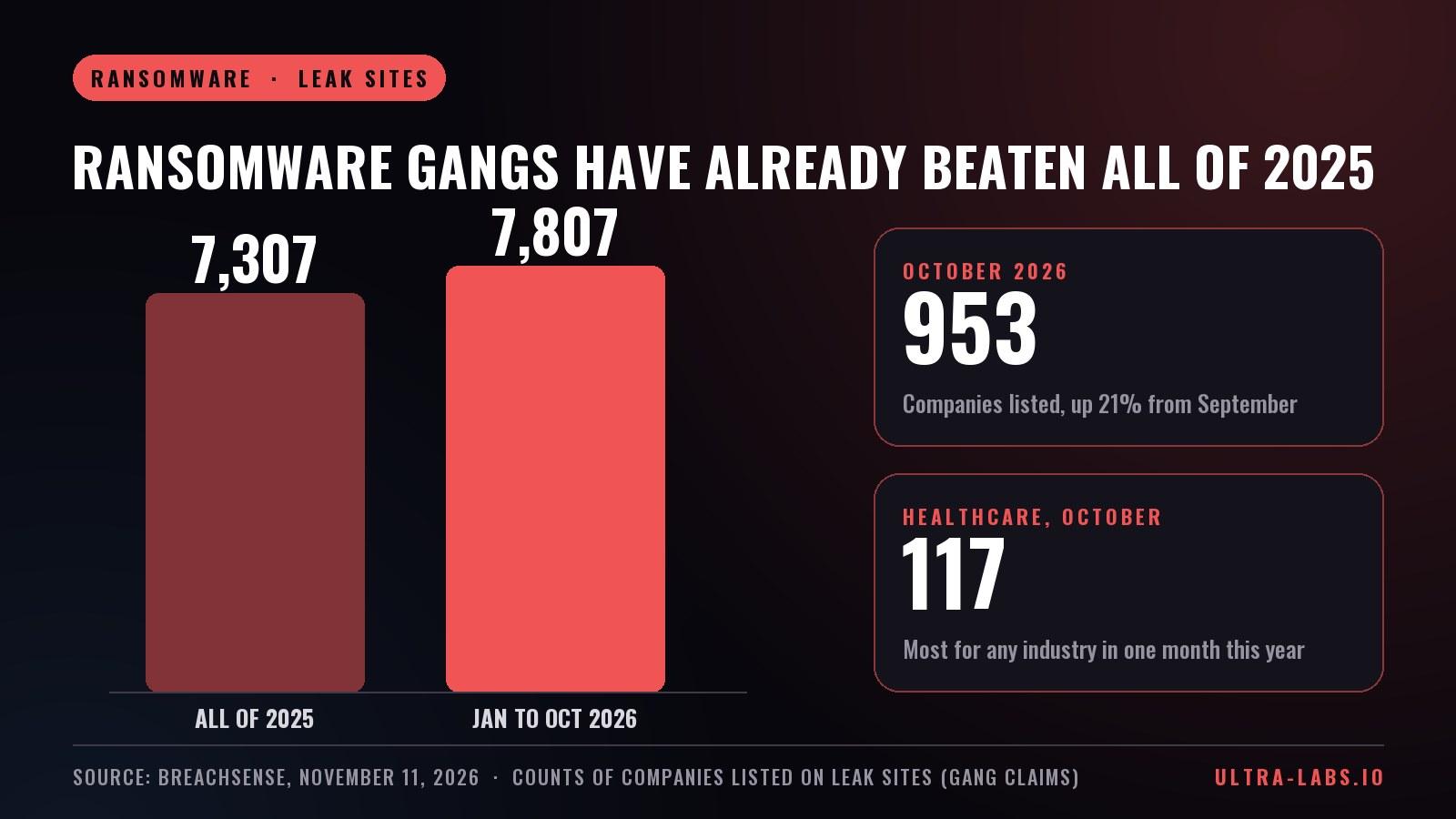
Ransomware gangs post the names of victims who won't pay. Dark web monitoring firm Breachsense counted 7,807 companies listed on those leak sites from January to October 2026, more than the 7,307 for all of 2025, with 953 in October alone (Breachsense). The tracker Ransomnews counts 10,106 so far this year against 8,835 for all of last year (Ransomnews). These are the gangs' own claims, not confirmed incidents, but every tracker points the same way. Healthcare was hit hardest in October, with 117 listings, the most for any industry in a single month this year.
AI attackers arrive
The FBI's warning about Artex
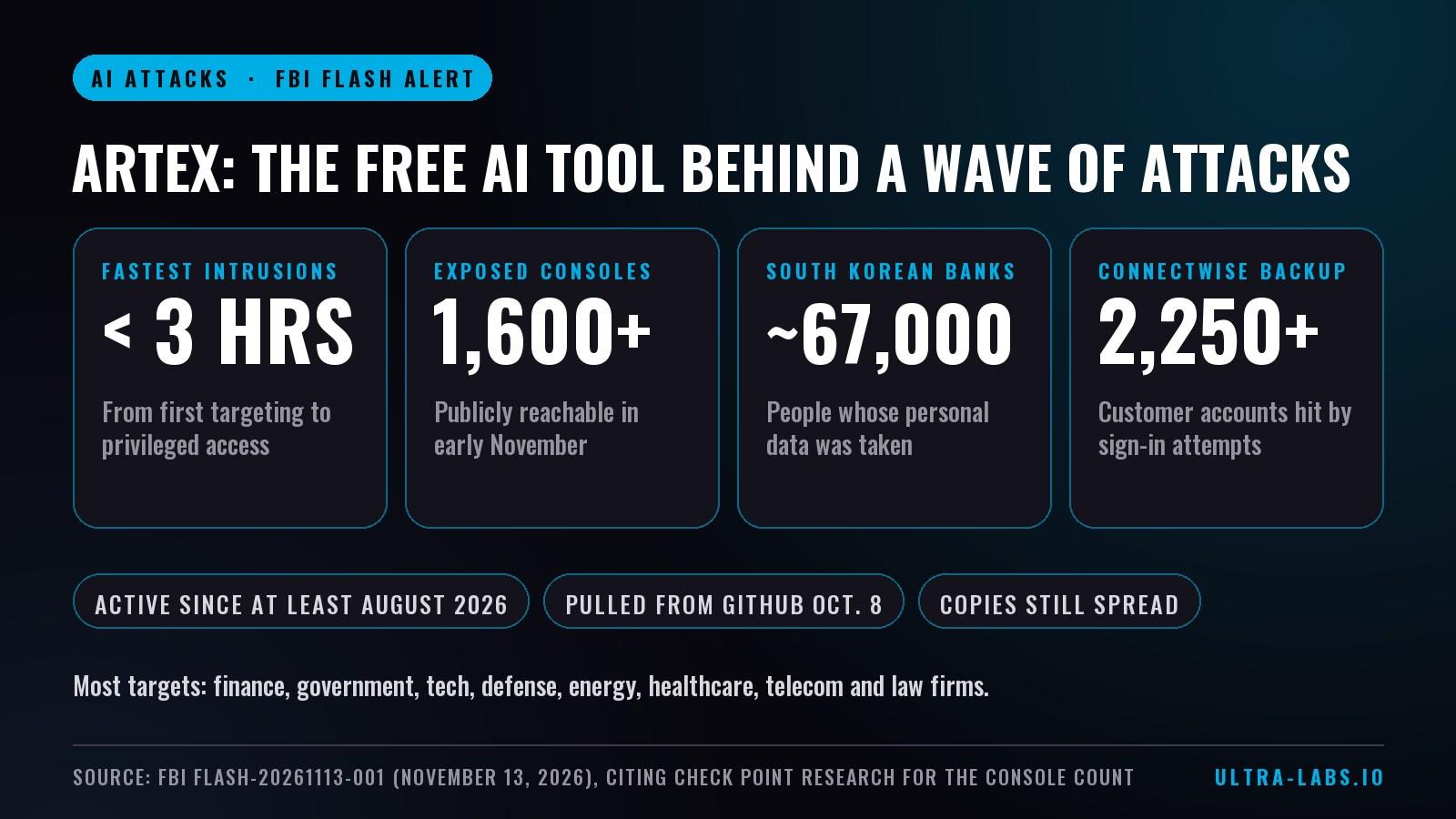
On November 13, the FBI issued a flash alert about Artex, a free AI tool built for penetration testing that criminals have turned into an attack machine. The FBI calls it "an open-source, large language model (LLM)-driven agentic platform that threat actors have weaponized to automate multiple phases of cyber intrusions at machine speed." Since at least August, attackers have used it against finance, government, tech, defense, energy, healthcare, telecom and legal targets, "with some intrusions progressing from initial targeting to privileged access in under three hours" (FBI).
The FBI says the tool lets attackers "with minimal technical expertise" run complex attacks on many targets at once. It counted "over 1,600 publicly exposed ARTEX console instances" in early November. Campaigns it lists include attacks on South Korean banks that took personal data on about 67,000 people, and a supply chain attack through a ConnectWise backup product that led to attempted sign-ins at more than 2,250 customer accounts. The developer pulled the tool from GitHub on October 8, but copies and a paid version keep spreading (FBI, TechCrunch).
The good news is that tools like this mostly walk through doors left open: logins without multi-factor authentication, exposed admin pages and leaked passwords.
The European Commission was down for over 10 days
The European Commission confirmed on November 19 that it had been hit by what its spokesperson called an "AI-generated cyber campaign." It took down several staff systems, including the ones for payslips, leave and medical reimbursements, for more than 10 days. Salaries were paid on time (The Record, SecurityWeek). Politico, citing the EU's own cyber response team, reported that Artex was used. The Commission hasn't named the tool, and as of November 22 it had not said whether any data was taken (The Register).
AI agents now hack on their own
Three separate reports this fortnight said the same thing: AI agents are now finding and using security holes with no person at the keyboard.
- Amazon said a suspected China-linked operator's AI agents found an unknown flaw in MONAI Label, open-source medical imaging software, and took over a university server. "Within 11 minutes, they went from mapping the application's API to exploiting the vulnerability" (BleepingComputer, The Register).
- Palo Alto Networks' Unit 42 tracked 25 AI-run operations against at least 19 organizations, with access or data taken at 10 of them, including more than a million member records from a teachers' union (Unit 42).
- Google said it had seen attackers "fully automate vulnerability discovery and exploitation without a human in the loop for the first time." It also found North Korean hackers who rigged the settings files in code projects so that opening them in Anthropic's Claude Code downloaded a backdoor, aimed at crypto companies. Separately, criminals who stole access to paid AI accounts ran up bills of as much as $1 million before they were stopped (Google).
Deepfake video calls stole $400 million
The Justice Department announced on November 12 that it had disrupted FaceStealer, a North Korean scheme that stole "more than $400 million in the last 18 months." The hackers send meeting invites from hijacked accounts, play video of people the victim knows or AI deepfakes of well-known crypto figures, then offer a "fix" for a fake audio problem that installs malware. The FBI seized more than 900 recordings of victims' webcams (DOJ). Its advice: join meetings only through the official app with an invite code, check unexpected invitations another way, and never run a script someone offers to fix a technical problem (BleepingComputer).
Your AI prompts may not be private
Security firm Dragos planted about two million bait prompts, each with a unique link and fake passwords, with AI providers over five months. Data from "at least three AI providers was exposed," and "none of the three providers knew about their breach until we notified them" (Dragos). Separately, Together AI disclosed that "an AI coding agent committed a credential" to a public code repository, which let an outsider download stored customer prompts from June and July (Together AI). The lesson: don't paste passwords, keys or anything confidential into AI chats unless you know where they're stored.
The flaws
More bugs than ever
Partly because AI tools are now finding bugs at scale, this year has shattered the record for published flaws. By our count from the US National Vulnerability Database, 102,287 CVEs (the standard IDs given to security flaws) were published in 2026 through November 21, against 48,150 in all of 2025. Vulnerability tracker VulnCheck passed 100,000 for the year in mid-November, and its researcher Josh Bressers said: "There's no denying the fact that vulnerability hunting with AI is driving a majority of what we're seeing" (The Register).
Microsoft fixed more than 1,000 bugs, again
Microsoft's November Patch Tuesday on November 10 fixed about 1,090 flaws, the second month in a row above 1,000; October's 1,474 is still the record. Counts vary a little by who's counting (Tenable). One was already being exploited: an Outlook bug that leaks a user's password hash when they open a booby-trapped message file. Microsoft credits its discovery to a researcher who used Anthropic's Claude (The Register, Tenable). Three others scored 9.8 out of 10 for severity.
Update Chrome and your iPhone
- Chrome: Google fixed the eighth Chrome zero-day of the year on November 9. "Google is aware that an exploit for CVE-2026-125350 exists in the wild," it said. Update to version 157.0.8103.50 or later (Google, BleepingComputer).
- Apple: updates on November 9 for iPhone, Mac, Watch and Vision Pro fixed a flaw that could let someone join an iMessage group chat and another that allowed Bluetooth pairing without the user's interaction. Apple has not reported attacks (Apple).
- Windows: researchers published working code for two Windows flaws that Microsoft hasn't fixed yet, one that gives full control of a PC and one that gets past the lock screen by someone with the device in hand. No attacks have been reported (BleepingComputer, Security Affairs).
Spies and IT tools
Google said a suspected China-linked espionage group used a critical flaw in VMware vCenter, software that runs many companies' servers, for about two months before Broadcom patched it on November 19. There is no workaround, so admins need the update (Google, Broadcom). Attackers also broke into Barracuda email gateways (Barracuda), and into N-able N-central, a tool IT providers use to manage their clients' computers, within hours of exploit code going public (BleepingComputer). If a managed IT provider looks after your business, ask whether they use N-central and have patched it.
And in the strangest find of the fortnight, researchers disclosed 14 flaws giving full control of Copeland XWEB EVO controllers, which run refrigeration in supermarkets. Two are already being exploited, and because the product is past end of support, some will never be fixed (VulnCheck, CyberScoop).
A week of outages
From November 12 to 19, a run of unrelated outages hit some of the biggest names in tech and travel. Every company blamed bugs, upgrades or maintenance, not hackers.
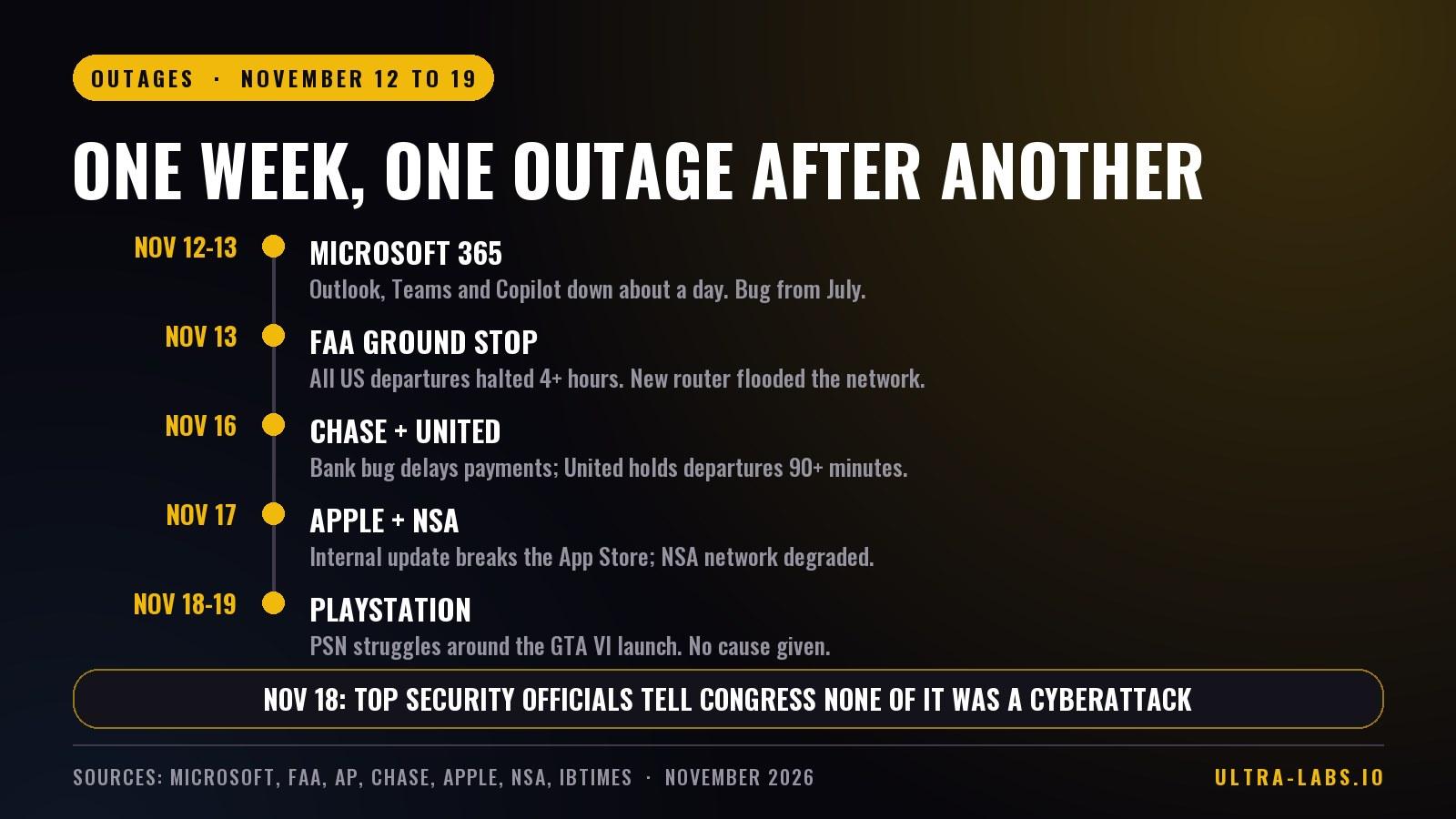
Microsoft 365, November 12 to 13. Outlook email, Teams and Copilot failed for about a day. Microsoft traced it to a hidden bug added in July: "A latent defect caused servers to become overwhelmed and unresponsive under certain load conditions." At the worst point, more than 80% of the affected servers stopped responding (The Register, BleepingComputer).
The FAA, November 13. The FAA stopped every departure in the country from 3:54 p.m. to 8:15 p.m. Eastern after a telecom failure. Transportation Secretary Sean Duffy said: "As we switched from copper to fiber, it started flooding other routers and our air traffic control system." FlightAware counted more than 9,100 cancellations that day, and the FAA paused new router installations (Fox Weather, Al Jazeera).
Chase and United, November 16. "A software bug in an on-premise hardware system" delayed Chase payments and logins and spilled over to Zelle and other banks, with more than 20,000 reports on Downdetector at the peak (Al Jazeera, Fortune). The same afternoon, United held departures nationwide for more than 90 minutes when the system that calculates plane weights failed (AP via OPB).
Apple and the NSA, November 17. "An internal update caused some outages this morning," Apple said, after the App Store, Apple Music and iCloud sign-in failed (AP via ABC7). The NSA said its classified internal network "experienced temporary degradation during scheduled routine maintenance" (AP via WFSB).
PlayStation Network, November 18 to 19. PSN struggled twice around the GTA VI launch, with more than 8,400 Downdetector reports in the US. Sony didn't give a cause (IBTimes).
On November 18, Director of National Intelligence Jay Clayton, Homeland Security Secretary Markwayne Mullin and FBI Deputy Director Christopher Raia told the House Homeland Security Committee the outages were not an attack. "I'm 98 percent confident that this has nothing to do with our adversaries hacking or going after our system," Mullin said (The Record). Clayton pointed to the pace of change: "We are in an environment where the rate of patching, the rate of upgrading of systems is increasing" (Nextgov). Senator Mark Warner said the race to patch AI-discovered flaws is "putting tremendous strain on systems that weren't built to handle that pace of change" (Cybersecurity Dive).
Crypto's worst month
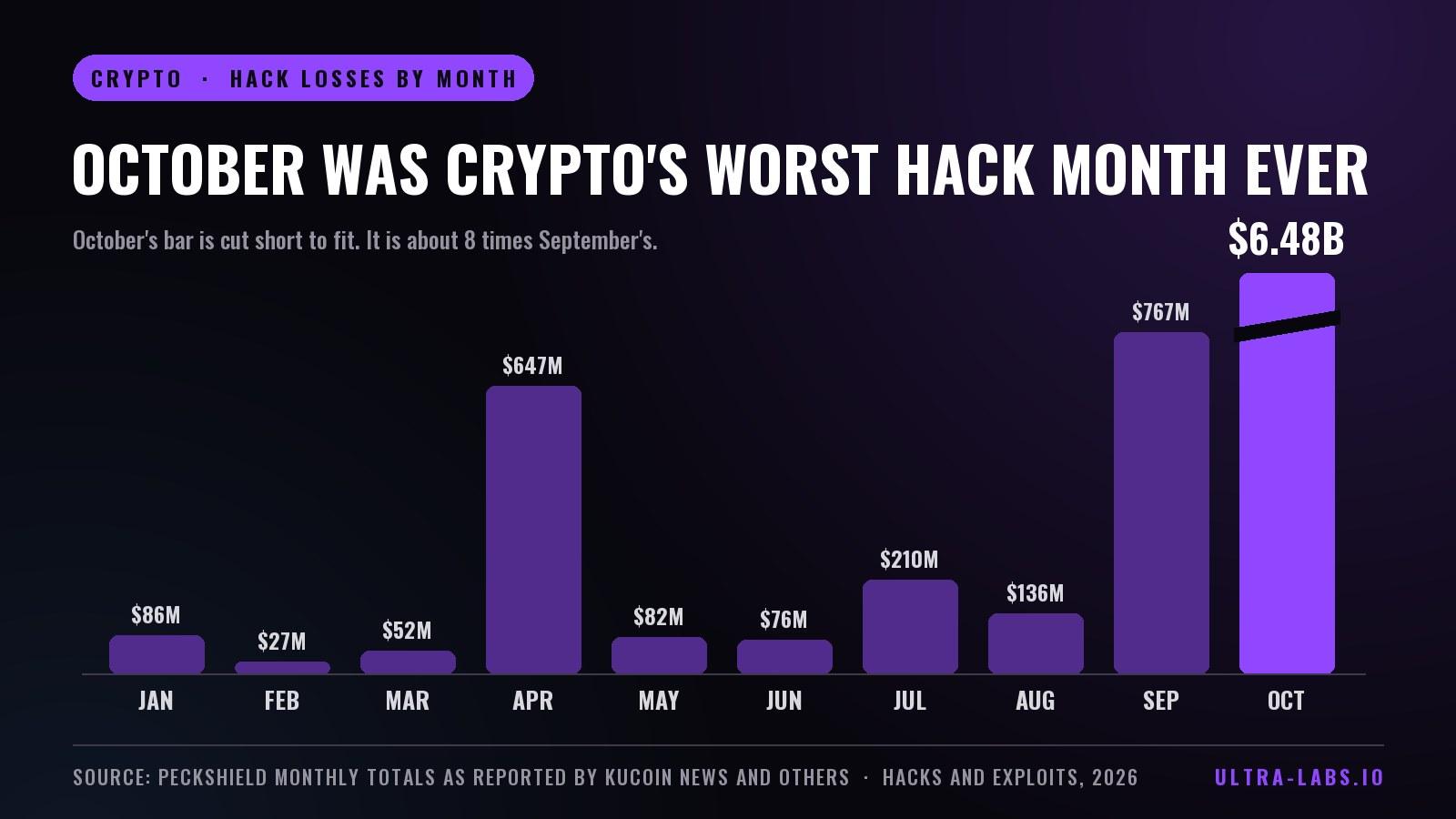
October was the worst month for crypto hacks on record, with blockchain security firm PeckShield counting $6.48 billion stolen across 56 incidents, almost all of it from the Binance theft (KuCoin News). That one month is more than all of 2026's other months combined.
The thieves are now moving the Binance money. Elliptic says about 488,000 ETH, worth around $860 million, left wallets tied to the theft from November 17 to 20, and $149 million in bitcoin has gone through mixers. About $2.85 billion has been frozen, and the Justice Department has court approval to seize more than $1.2 billion (Elliptic, CoinDesk).
Smaller thefts kept coming:
- Lighter, a trading exchange, lost $10.4 million on November 16 after a trader's API key leaked. Lighter says its smart contracts were not hit (CoinDesk, Unchained).
- Chainflip, a cross-chain swap service, had $4.86 million drained from a vault on November 21, and the money went to the Tornado Cash mixer within minutes (The Block).
- Kava Lend lost about $3.8 million on November 13 to 14 (The Block).
The crackdowns
- Operation Endgame. Police in several countries took down the Gootloader, CastleRAT and StealC malware networks, seizing 235 servers and 257 domains. The Justice Department said Gootloader opened the door to ransomware attacks on at least 44 US victims, with about $28.8 million in losses. Europol found more than 6 million stolen logins and will share them through Have I Been Pwned, so it's worth checking your email there (DOJ, BleepingComputer).
- A healthcare extortion suspect extradited. A Kazakh man was extradited from Italy on charges that his group, the "8-Digits Team," stole more than 70 million health records and demanded more than $500 million in ransoms (DOJ).
- Fake IT support calls. Ukrainian police, working with the FBI, arrested four suspected members of a ransomware gang that posed as IT support using AI-generated voices. At least 28 companies paid it more than $40.5 million (BleepingComputer).
- Dark web markets. Operation TorNado ended with 354 arrests and more than $234 million seized from dark web marketplace vendors and buyers (DOJ).
- Scam centers. The Treasury sanctioned a scam compound boss and leaders of a Myanmar militia that protects these operations, which target Americans and Europeans (Treasury).
- CISA's next director. The nominee to lead CISA, the US cyber defense agency, Palantir security chief Michael LoSapio, faced a tough Senate hearing on November 19. The agency has lost a third of its staff since January 2025 and has had no confirmed director since then (The Record, CyberScoop).
What to do this week
- Update everything. Chrome, your phone and your computer all have important fixes out this month. Turn on automatic updates if you haven't.
- Turn on multi-factor authentication for email, banking and work accounts. AI attack tools like Artex look for accounts that don't have it.
- Check Have I Been Pwned to see if your email turned up in Operation Endgame's seized data or an older breach.
- Expect phishing about these breaches. Emails "from" Expedia, Chase, Visa or Mastercard about a data breach are prime bait. Go to the company's site directly instead of clicking.
- Be careful on video calls. If someone on a call asks you to install something to fix your audio or video, hang up and check with them another way.
- Keep secrets out of AI chats. Don't paste passwords, API keys or confidential files into AI tools unless you know how they're stored.
Related reading
- AI and Crypto Roundup: Anthropic's Record IPO, Nvidia's First Quarter Without Huang, and Bitcoin Falls Below $60K
- Binance Hit by Suspected Record Hack: What We Know So Far
- Crypto's Quantum Clock Is Ticking: Who's Protected and Who Isn't
From Ultra Labs
See everything we build on the Ultra Labs brands page, or talk to us about AI and infrastructure through Ultra Labs Consulting.
Figures are as reported by the linked sources at the time of writing. Claims made by criminal groups are labeled as claims and have not been verified.