
Bitcoin Mining in 2026: Air, Hydro, Immersion, and the Bitaxe Revolution
Not all Bitcoin mining looks the same in 2026. From warehouse-scale immersion tanks to a $200 open-source board sitting on your desk, the hardware spectrum has never been wider. Here's what's actually running, what it costs, and what makes sense for different operators.
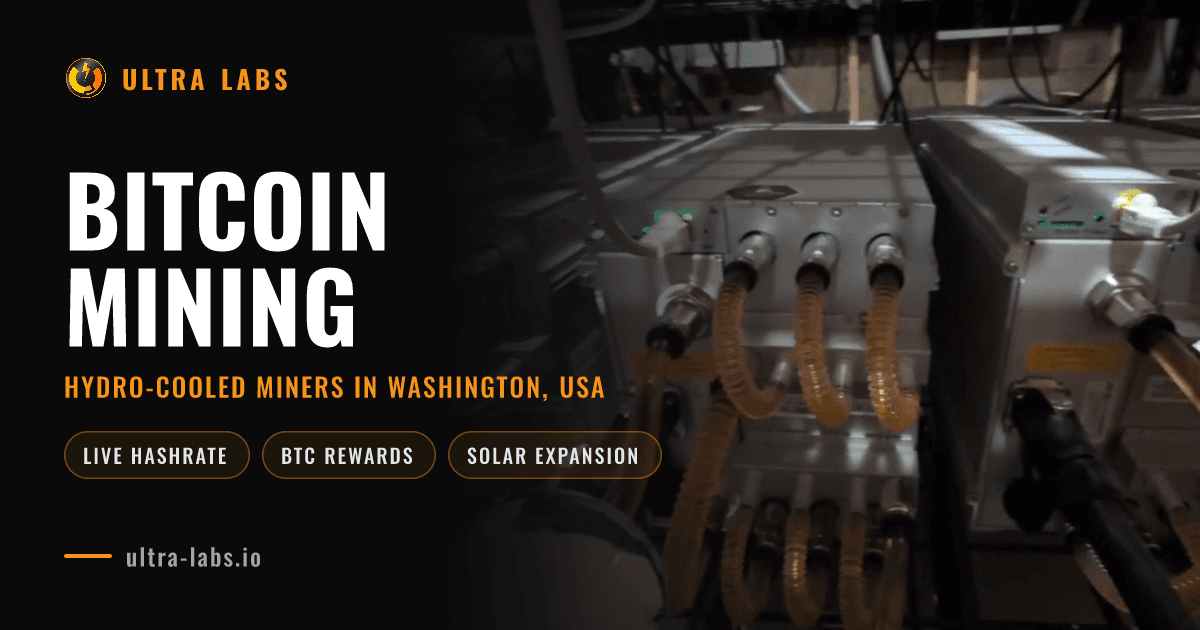
Bitcoin mining has evolved a lot in the last several years. Here is a look at the variety of mining hardware available in 2026.
The options have never been more varied, the efficiency benchmarks have never been tighter, and the decision of which setup to run is no longer just about price per terahash. It's about energy source, deployment environment, capital structure, and frankly, what kind of operation you want to be running five years from now.
Let's break down what's actually out there.
Hydro-Cooled Mining: Enterprise Scale, Real Efficiency Gains
Ultra Labs currently runs 58 hydro-cooled Bitcoin miners in the Pacific Northwest and is aiming to quadruple our mining footprint over the next year.
Hydro (liquid-cooled) mining is our specialty, and where the serious institutional money is going right now. There's a clear reason: you can run more hashrate in a smaller physical footprint, at lower temperatures, with meaningfully better efficiency than the equivalent air-cooled hardware.
Our primary unit is the Bitmain Antminer S21 XP Hydro: 473 TH/s at 12 J/TH on 5,676W. That's a meaningful step up from the previous-generation S21 Hydro (335 TH/s at 16 J/TH), and the efficiency delta over even the best air-cooled hardware is significant when power is your primary variable cost. But the real advantage isn't just the headline efficiency number. It's that you can deploy these units at much higher density, chip temperatures are dramatically lower (extending hardware lifespan), and the heat is extractable as warm water rather than hot air.
That extractable heat is where things get interesting for operators who are thinking creatively about energy economics. Warm water at 40-50°C can be used for industrial heating, greenhouse operations, district heating in colder climates, or fed into existing HVAC infrastructure. We're seeing mining operations in Scandinavia and Canada heat entire facilities and sometimes neighboring buildings off mining waste heat. That's not a fringe use case anymore, it's a real part of the unit economics for sophisticated operators.
Looking Ahead: The S23 Hydro
Bitmain is now shipping the Antminer S23 Hydro: 580 TH/s at 9.5 J/TH, with the 3U rack-mount variant doubling that to 1,160 TH/s in a single chassis. Sub-10 J/TH hydro is a genuine step change: it opens up power sources and geographies that simply can't compete at 12 J/TH. We don't have S23s yet, but they're on the roadmap for our next infrastructure expansion.
Who's deploying hydro at scale:
The large publicly traded miners, including Riot Platforms, Core Scientific, and Bitfarms, are all investing in hydro-cooled infrastructure for their next-generation builds. It's also where you see sovereign and institutional deployments, large capital requires the kind of efficiency and uptime guarantees that air cooling can't reliably deliver at scale.
The capital reality:
Hydro cooling requires significant upfront infrastructure investment. You need a closed-loop water cooling system, heat exchangers, pump infrastructure, and in most cases purpose-built facilities. The per-unit cost of a hydro-cooled machine is higher than the air-cooled equivalent, and you're locked into a more complex maintenance regime.
For smaller operators, the math often doesn't work. For institutional deployments at 50MW or above, it increasingly does.
Air-Cooled Mining: Still the Backbone of the Industry
Air cooling is boring and cost effective. That's exactly why it still dominates.
The majority of Bitcoin's ~880 exahash per second (EH/s) global hashrate is still being generated by air-cooled ASICs in data centers, warehouses, and converted shipping containers. The technology is mature, the supply chain is deep, and the failure modes are well understood. When something breaks on an air-cooled unit, any competent electrician and a $40 part can usually fix it.
The current-generation air-cooled standard is the S21 Pro / S21 XP class of machines. The S21 XP runs around 270 TH/s at approximately 13.5 joules per terahash (J/TH), which is significantly better than anything available three years ago. For context, the S19 Pro that defined the previous generation ran closer to 30 J/TH. That is not a typo: the efficiency curve over three years has been steep. The efficiency curve has been steep.
The Pros:
Air-cooled makes sense for operators who have access to low-cost power, reasonable ambient temperatures, no close neighbors, and don't want the capital complexity of more exotic cooling infrastructure.
Air cooling wins on flexibility. You can easily redeploy machines to a new location, sell individual units into liquid secondary markets, and swap models as newer generations arrive without retooling your entire facility.
The Cons:
The efficiency ceiling for air cooling is real. At some point, forcing ambient air across a heat sink is a thermodynamic limitation, not just an engineering one. As the global difficulty climbs and margins compress, the operators who squeeze out every joule per terahash are the ones who survive down cycles. Air-cooled machines are getting close to their practical efficiency limits. The future of big hashrate gains is in liquid cooling, not just chip design.
Noise is also significant. A 270 TH/s ASIC sounds like a jet engine. In a dedicated facility that's a non-issue. In any other environment, it's a major nuisance.
Immersion Cooling: The Highest Efficiency Ceiling in the Industry
Immersion cooling is exactly what it sounds like: you drop the ASIC hardware directly into a bath of non-conductive dielectric fluid, which absorbs heat far more efficiently than air. The chip runs cooler, the hardware lasts longer, and you can push clock speeds that would destroy an air-cooled machine.
There are two main approaches, and the economics are quite different.
Single-phase immersion uses a synthetic dielectric oil (often mineral-oil-based or purpose-formulated fluids from companies like Engineered Fluids or Submer). The hardware sits submerged, the fluid absorbs heat, and it cycles through external heat exchangers to cool. Single-phase fluid doesn't boil at operating temperatures. It's simpler, less expensive per tank, and more accessible to operators who want immersion economics without the complexity of two-phase.
Efficiency gains over air-cooled equivalents run roughly 10-15% in real-world deployments, and chip lifespan is meaningfully extended because you've eliminated thermal cycling stress. The hardware vendors are starting to pay attention: Bitmain, MicroBT, and several newer entrants are shipping "immersion-ready" machines with modified heatsink configurations.
Two-phase immersion is the high-end of the spectrum. You use a specialized engineered fluid (historically 3M Novec, though the refrigerant transition is pushing operators toward alternative formulations) that boils at low temperatures. The hardware sits in the liquid, the fluid boils off heat as vapor, condenses back on cooled coils, and returns as liquid in a closed loop. Chip temperatures are extremely stable. Efficiency gains can reach 20% over air-cooled equivalents, and the hardware can be run harder.
The catch: The fluid is expensive. The containment infrastructure is complex. And when something goes wrong, you're fishing expensive hardware out of a boiling chemical bath. It's genuinely a different operational skill set than running air-cooled machines.
The heat reuse angle:
Immersion cooling excels at heat capture, especially two-phase. The extracted heat is high quality (usable temperatures) and concentrated, making it the preferred approach for operations that are selling waste heat as a secondary revenue stream. We're watching several operators in the UK and EU build combined mining plus district heating systems on immersion infrastructure specifically because the regulatory environment incentivizes heat reuse.
Who it's for:
Immersion makes the most sense for operators who are comfortable with the infrastructure complexity, have access to capital for the upfront tank and fluid costs (a single commercial immersion tank plus fluid can run $80,000 to $200,000 before you put a single machine in it), and are optimizing for maximum efficiency over long deployment horizons.
It's not a setup for someone scaling from 10 machines to 50. It's a setup for someone building a facility and thinking in five-year capital cycles.
Decentralized Mini Miners: The Bitaxe Revolution
Now for the part of this post that I'll admit is at least partly philosophical.
The Bitaxe is a small, open-source, single-chip Bitcoin mining board originally designed by skot9000 on GitHub and built on the BM1366 ASIC chip (the same chip family used in Bitmain's S19 XP series). A Bitaxe runs somewhere in the 2-4 TH/s range depending on the variant and configuration, consumes around 15-25 watts, costs $150-250 depending on where you source it, and sits on your desk looking like a large Arduino.
It will almost certainly never mine a block. At current difficulty and hashrate levels, a solo miner at 4 TH/s hitting a block is a lottery ticket event. We're talking probabilities in the range of once every several thousand years at expected value.
So why do I have one on my desk, and why do I think it matters?
Because decentralization is not a talking point. It's the whole point.
Bitcoin's security model depends on geographic and organizational distribution of hashrate. Right now, that hashrate is increasingly concentrated in a small number of large, publicly listed mining companies, institutional capital pools, and government-affiliated operations. That's not inherently bad, but it creates systemic risk and political surface area that a fully decentralized network doesn't have.
The Bitaxe represents something genuinely different: a hardware design that is completely open-source, buildable by anyone with basic electronics skills, repairable with commodity components, and deployable in a living room. The Bitaxe community on GitHub has hundreds of contributors. There are dozens of hardware variants. People are building them in garages, running them on solar panels, contributing patches to the firmware, and generally doing what open-source hardware does at its best.
Is it economically rational? No. Is it philosophically important? Absolutely.
The Bitaxe as signal:
Beyond the philosophy, the Bitaxe tells you something practically useful: the ASIC chips used in the largest industrial miners are not magical. The core technology is reproducible, iterable, and improvable by a distributed community of engineers who are not beholden to any single manufacturer. That matters for the long-term health of the mining hardware market.
There are now commercial mini-miner products influenced by the Bitaxe's success, from companies like FutureBit (the Apollo BTC), which sells purpose-built home mining units in the 100W range. These products wouldn't exist without the open-source movement proving the market.
Who should run one:
Anyone who wants to genuinely understand Bitcoin mining from first principles. Educators. Hobbyists. Anyone who wants to maintain a philosophical connection to the network's early ethos while the institutional wave rolls in. And anyone who, like me, finds it instructive to have a small machine running on your desk as a reminder of what this thing is supposed to be.
The Bigger Picture
Bitcoin's global hashrate has never been higher. The machines have never been more efficient. And the range of ways to participate, from a $200 open-source board to a $200 million hydro-cooled data center, has never been wider.
At Ultra Labs, hydro is our primary stack: 58 machines running in the Pacific Northwest, with plans to scale significantly over the next year. We run air-cooled units where the energy profile and capital structure support it, and we are watching immersion closely for future infrastructure phases. And we keep a Bitaxe running because we think the decentralized mining movement is worth supporting even when it isn't the most profitable decision in the room.
The question for any operator in 2026 is not which cooling technology is theoretically best. It's which setup fits your energy source, your capital, your operational skills, and your time horizon.
Bitcoin rewards patience and preparation. So does mining infrastructure.
Ultra Labs operates the ULTRA Pool on Cardano, and operates Bitcoin miners in the Pacific Northwest. Ultra Labs is a US Bitcoin mining and AI technology company. Read more: Bitcoin 2026 Las Vegas Conference & Mining Outlook · BlackRock Is Testing Its Tokenized Fund on Cardano
Ultra Labs is a US Bitcoin mining and crypto infrastructure company powered by renewable energy and built on decentralized infrastructure. This article is for informational purposes only and is not financial, investment, legal, or tax advice. Ultra Labs publications are produced with the assistance of artificial intelligence and reviewed by humans, and may contain inaccuracies. Always do your own research before making investment decisions.